Question 5 · What can be done, and what is it like to live with?
What can be done, and what living with it is like
The hair loss market is loud. Balds doesn't sell anything or rank treatments. These guides set out what each option involves, according to the medical sources, so you can have a clear conversation with a doctor or decide not to treat at all.
Start with the cause. The American Academy of Dermatology says effective treatment begins with finding it, and no single treatment works for everyone. 1 Some hair loss regrows on its own, such as shedding after an illness. 1 If you don't yet know what yours is, our guide to understanding hair loss is the place to begin.
At a glance
The main options for pattern hair loss
| Option | What it involves | Good to know |
|---|---|---|
| Minoxidil | Applied to the scalp; sold without a prescription; FDA-approved for men and women 4 5 | Six to 12 months to judge; benefit lost if you stop 5 |
| Finasteride | A daily prescription pill for men 4 6 | Side effects to discuss before starting 6 |
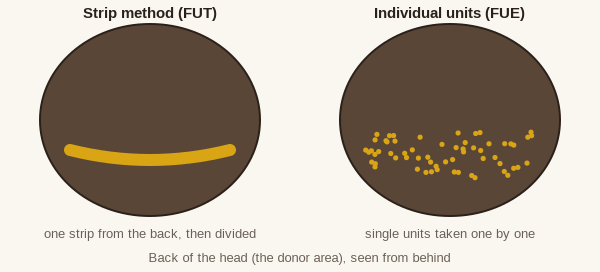
| Hair transplant | Surgery moving hair from the back and sides 7 | Donor hair is limited; not usually covered by insurance 8 7 |
| Cosmetic options | Haircuts, fibers, wigs, scalp tattooing, shaving 7 9 | Immediate and reversible |
| No treatment | Letting it run its course 3 | A legitimate choice 4 |
Our guide to what each option involves covers these and others in full.
All guides
Options, treatments and everyday life
- Hair loss treatment options: what each one involvesMedicines, procedures, devices, cosmetic cover and doing nothing, set out side by side: what each involves, how long before you can judge it, and what happens if you stop. No rankings.
- Biotin and hair supplements: what the evidence saysBiotin is the most heavily marketed hair vitamin. Deficiency is rare, the evidence for healthy people is thin, and high doses can throw off important blood tests.
- Finasteride for hair loss: what to discuss with a prescriberA daily prescription pill for male pattern hair loss. How it works, how long it takes to judge, the side effects people ask about most, and the questions worth raising before you start.
- Hair transplants: FUE vs FUT, and the questions to ask a clinicThe two ways surgeons take donor hair, what each means for scars and recovery, who is a good candidate, and the questions that separate a careful clinic from a risky one.
- How to protect a thinning or bald scalp from the sunLess hair means more sun on the scalp. Here is what dermatologists suggest: a hat or sunscreen, the easiest forms to use, and when to reapply.
- How to shave your head, and look after the scalp afterFor many people with hair loss, shaving it off is the decision that ends the worry. A dermatologist-informed guide to doing it comfortably, avoiding bumps, and protecting a bare scalp from the sun.
- How to spot a hair loss scamHair loss is one of the most heavily marketed health worries. The warning signs in product claims, why "growth shampoos" can't do what their labels imply, and how to check before you spend.
- How to style thinning hair, including a receding hairlineCuts, parts, products and cover-ups that make thinning hair look fuller, for women and men, plus the styling habits that make thinning worse.
- Laser caps and combs for hair loss: what does the evidence say?Home laser devices explained: what they are, what "FDA cleared" means, what one key study found, and what to ask before buying.
- Minoxidil: what it involves and what to ask a doctorThe most widely used hair loss treatment, sold without a prescription. How it is used, how long before you can tell, the side effects, and the questions worth asking first.
- What is PRP for hair loss, and what does the evidence say?Platelet-rich plasma uses your own blood, injected into the scalp over repeat visits. Here is what a session involves and how cautious the sources are.
- Wigs, toppers and hairpieces: how to choose, wear and care for themSynthetic or real hair, full wig or topper, plus comfort, scalp care and where to look for help with the cost.
- American Academy of Dermatology, “Hair loss: Diagnosis and treatment”. aad.org/public/diseases/hair-loss/treatment/diagnosis-treat
- American Academy of Dermatology, “Hair loss: Signs and symptoms”. aad.org/public/diseases/hair-loss/insider/begin
- Mayo Clinic, “Hair loss - Symptoms and causes”. mayoclinic.org/diseases-conditions/hair-loss/symptoms-causes/syc-2037292
- American Academy of Dermatology, “What is male pattern hair loss, and can it be treated?”. aad.org/public/diseases/hair-loss/treatment/male-pattern-hair-loss-treat
- American Academy of Dermatology, “Thinning hair and hair loss: Could it be female pattern hair loss?”. aad.org/public/diseases/hair-loss/types/female-pattern
- MedlinePlus (NIH), “Finasteride: MedlinePlus Drug Information”. medlineplus.gov/druginfo/meds/a698016.html
- Mayo Clinic, “Hair loss - Diagnosis and treatment”. mayoclinic.org/diseases-conditions/hair-loss/diagnosis-treatment/drc-203
- ISHRS, “FUE Hair Transplant: Benefits, Process & Recovery”. ishrs.org/fue-what-is-it/
- NHS, “Hair loss”. nhs.uk/symptoms/hair-loss/
- ISHRS, “FUT Hair Transplant: Benefits, Procedure & Recovery”. ishrs.org/fut/