The right option depends on the cause, so the first step is a diagnosis. 1 For pattern hair loss, the FDA-approved medicines are topical minoxidil and, for men, finasteride; both take months to judge and only help while used. 2 3 Procedures such as hair transplants, devices such as home lasers, and cosmetic options like wigs, fibers and shaving are the other routes. 4 5 Doing nothing is a legitimate choice too. 6
The hair loss market is crowded and loud. Products promise regrowth, clinics promise permanent results, and forums argue about which is "best". Balds doesn't sell anything or rank treatments. This page does something more useful: it sets out what each option actually involves, according to the medical sources, so you can have a clear conversation with a doctor.
Step one is always the cause
The American Academy of Dermatology says effective treatment begins with finding the cause, and that no single treatment works for everyone. 1 Shedding after an illness, alopecia areata, a scalp infection and pattern hair loss all need different things. Some need nothing. The AAD says hair may regrow on its own after recovery from a major illness or surgery, or in a mild case of alopecia areata. 1
Some treatment is for the cause, not the hair. If a disease is behind the loss, Mayo Clinic says treating that disease is necessary, and if a medicine is the cause, a doctor may advise stopping it for a few months. 4 So this page is mostly about pattern hair loss, the most common type. 6 If your loss is patchy, scarring or sudden, the options are different. Our guides to alopecia areata, scarring hair loss and sudden shedding cover those.

The options side by side
| Option | What it is | Prescription? | How long to judge | If you stop |
|---|---|---|---|---|
| Minoxidil | A liquid or foam applied to the scalp 4 | No; FDA-approved for men and women 2 3 | Six to 12 months 3 2 | The benefit is lost and shedding increases 2 |
| Finasteride | A daily pill that lowers DHT 7 8 | Yes; FDA-approved for men only 2 7 | At least 3 months; up to 12 7 | Hair loss returns 2 |
| Other prescription pills | Such as spironolactone for women 3 | Yes; used off-label 3 | 6 to 12 months 3 | Regrown hair is lost in about three to four months 3 |
| Hair transplant | Moving hair from the back and sides to thinning areas 4 9 | A surgical procedure 4 | Up to a year for full results 10 | Transplanted hair is meant to be permanent, but hair loss is a dynamic process and many people need more than one surgery 2 11 |
| Home laser devices | Caps and combs that emit low-level light 1 | No; some FDA-cleared 2 | Studies used 26 weeks 1 | Must keep using to see results 3 |
| Platelet-rich plasma (PRP) | Your own processed blood injected into the scalp 2 | An in-office procedure 2 | A few months 2 | Needs repeat sessions every three to six months 2 |
| Cosmetic cover | Styling, fibers, sprays, wigs, scalp tattooing, shaving 5 12 4 | No | Immediate | Nothing changes |
Minoxidil
Minoxidil is the most widely used option. The AAD calls it the most commonly used treatment for male pattern hair loss and the most recommended for female pattern hair loss. 2 3 Mayo Clinic says it comes as a liquid, foam or shampoo, applied once daily for women and twice daily for men. 4
The key facts are about time and commitment. It takes months to judge, and the AAD says shedding may increase for the first two to eight weeks. 3 It only works while you use it. 2 MedlinePlus notes it does not cure baldness and has no effect on receding hairlines. 13 Common side effects are scalp irritation and unwanted hair growth on nearby skin. 4 Our minoxidil guide has the questions to ask.
Finasteride
Finasteride is a prescription pill for men. It blocks the enzyme that turns testosterone into DHT. 8 MedlinePlus says it may take at least 3 months to see improvement, and that it only slows hair loss while you take it. 7 It is for use in men only, and women who are or may become pregnant should not touch broken or crushed tablets. 7
It has side effects worth discussing properly. MedlinePlus lists decreased sexual desire, ejaculation problems and erection problems, which may occur during and after treatment. 7 It also lists new or worsening depression as a reason to call a doctor. 7 The AAD says a dermatologist will want to know about you before prescribing it. 2 Our finasteride guide covers this in detail.

Procedures
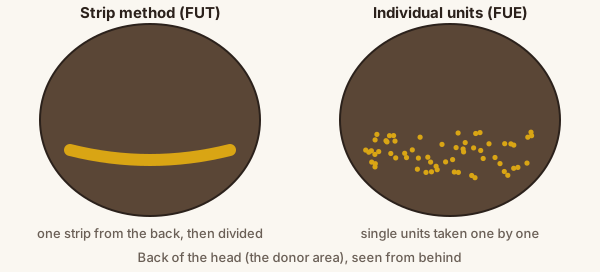
Hair transplants move hair-bearing follicles from the back and sides of the head, where hair is usually permanent, to thinning areas. 4 14 Mayo Clinic says the procedure doesn't require a hospital stay, and that surgery for baldness isn't usually covered by insurance. 4 Not everyone is a candidate. The AAD says women whose hair is sparse all over may not have enough donor hair. 3 Our guide to FUE and FUT transplants explains the two techniques.
Platelet-rich plasma uses a small amount of your blood, spun to separate the plasma, which is injected into the scalp. The AAD says sessions are monthly for the first three months, then every three to six months. 2 The AAD says more studies are needed on its safety and effectiveness for female pattern hair loss. 3
Devices
Home laser caps and combs are sold without a prescription. The AAD says only a few studies have looked at them, that not everyone who used one saw regrowth, and that more studies are needed on who benefits and on long-term side effects. 1 DermNet calls low-level laser therapy of unproven benefit in pattern balding. 16 The AAD explains that "FDA cleared" means the agency recognizes a device as safe, and that clearance is much less demanding than FDA approval. 2
Microneedling devices are also sold for hair. The AAD advises checking with a dermatologist first, because microneedling can worsen some conditions and the right device matters. 1
Cosmetic options
Covering or changing the look of hair loss is a real option, not a lesser one. Mayo Clinic suggests volumizing products, coloring, a hairstyle that makes a wide part less noticeable, wigs or extensions, or shaving your head. 4 The NHS lists wigs, and tattooing that looks like short hair. 5 DermNet mentions colored sprays and hair-building fibers. 12 Mayo Clinic notes that insurance may cover a wig if hair loss is due to a medical condition. 4

Combining options
Options are often used together rather than chosen one at a time. The AAD says minoxidil tends to work better alongside another treatment. 1 It says finasteride can be taken alone or with minoxidil, and that a dermatologist may add a prescription medicine to minoxidil to improve results. 2 PRP can be used alone or before a hair transplant. 2 For women, the AAD notes that dermatologists may use more than one treatment to get the best result. 3
Medicine and surgery are linked too. The ISHRS, the professional society for hair restoration surgeons, says a surgeon who hasn't discussed medical therapy for ongoing hair loss, especially in a man, may be a red flag. 15
Costs and practicalities
Most of these options are long-term and many are paid for privately. The NHS says treatments are not all available on the NHS and can be expensive if you have to pay, and that they only work for as long as they are used. 5 Mayo Clinic says surgery for baldness is not usually covered by insurance. 4 The ISHRS says transplants are rarely covered by insurance, and advises discussing costs and any payment plan openly before surgery. 17 Insurance may cover a wig when hair loss is due to a medical condition, according to Mayo Clinic. 4 Ask about generic versions of medicines, too; Mayo Clinic lists it among the questions worth asking. 4
Doing nothing
Mayo Clinic notes that some people prefer to let hair loss run its course untreated and unhidden. 6 The NHS says most hair loss doesn't need treatment, either because it is a normal part of getting older or because it is temporary. 5 The AAD says you don't need to treat male pattern hair loss. 2 Choosing not to treat is a decision, not a failure. Our guide to shaving your head is for people taking that route.
What to be wary of
The AAD says hair loss shampoos can make hair look fuller and reduce breakage, but cannot regrow hair or stop loss getting worse. 3 In most studies, supplements had no effect on hair growth and thickness. 3 The NHS notes that most treatments only work for as long as they are used, and that many are expensive. 5 Our guide to spotting hair loss scams lists the warning signs in marketing.
- American Academy of Dermatology, “Hair loss: Diagnosis and treatment”. aad.org/public/diseases/hair-loss/treatment/diagnosis-treat
- American Academy of Dermatology, “What is male pattern hair loss, and can it be treated?”. aad.org/public/diseases/hair-loss/treatment/male-pattern-hair-loss-treat
- American Academy of Dermatology, “Thinning hair and hair loss: Could it be female pattern hair loss?”. aad.org/public/diseases/hair-loss/types/female-pattern
- Mayo Clinic, “Hair loss - Diagnosis and treatment”. mayoclinic.org/diseases-conditions/hair-loss/diagnosis-treatment/drc-203
- NHS, “Hair loss”. nhs.uk/symptoms/hair-loss/
- Mayo Clinic, “Hair loss - Symptoms and causes”. mayoclinic.org/diseases-conditions/hair-loss/symptoms-causes/syc-2037292
- MedlinePlus (NIH), “Finasteride: MedlinePlus Drug Information”. medlineplus.gov/druginfo/meds/a698016.html
- DermNet, “Finasteride”. dermnetnz.org/topics/finasteride
- American Academy of Dermatology, “A hair transplant can give you permanent, natural-looking results”. aad.org/public/diseases/hair-loss/treatment/transplant
- Cleveland Clinic, “Male Pattern Baldness (Androgenic Alopecia): Stages, Treatment”. my.clevelandclinic.org/health/diseases/24515-male-pattern-baldness-andro
- ISHRS, “Maximizing the Donor Area in Hair Transplant Surgery”. ishrs.org/donor-area-hair-transplant/
- DermNet, “Female pattern hair loss”. dermnetnz.org/topics/female-pattern-hair-loss
- MedlinePlus (NIH), “Minoxidil Topical: MedlinePlus Drug Information”. medlineplus.gov/druginfo/meds/a689003.html
- ISHRS, “FUE Hair Transplant: Benefits, Process & Recovery”. ishrs.org/fue-what-is-it/
- ISHRS, “FUT Hair Transplant: Benefits, Procedure & Recovery”. ishrs.org/fut/
- DermNet, “Male pattern hair loss (androgenetic alopecia, balding)”. dermnetnz.org/topics/male-pattern-hair-loss
- ISHRS, “Ask your Hair Restoration Surgeon: Questions to Have Confidence Before Surgery”. ishrs.org/questions-ask-your-hair-doctor/
- American Academy of Dermatology, “Hair loss: Signs and symptoms”. aad.org/public/diseases/hair-loss/insider/begin
General information, not medical advice. This article was drafted with AI assistance and checked against the sources listed above. Nobody at Balds is a doctor. If something here is wrong or out of date, tell us.