Both methods move hair from the back and sides of the scalp to thinning areas. FUT removes a strip of scalp that is divided into grafts, leaving a linear scar; FUE removes small units one by one, leaving tiny scattered scars and usually a faster recovery. 1 2 Neither is scarless. 3 Donor hair is limited and doesn't grow back, so choosing a qualified, physician-led surgeon matters most. 1
Hair transplants have changed a lot. The American Academy of Dermatology notes that most surgeons now move healthy hairs a few at a time, which avoids the unnatural, doll-like look of older plug transplants. 4 Today the main choice patients hear about is between two ways of taking donor hair: FUT and FUE.
This guide explains both, who tends to be a good candidate, and how to vet a clinic. It is not a recommendation for surgery.
How a transplant works
Pattern hair loss spares hair at the back and sides of the head. A transplant moves some of that hair to thinning areas. Mayo Clinic says hair is removed from a part of the head that has hair and moved to a bald spot, in grafts containing one to several hairs. 5 The ISHRS, the professional society for hair restoration surgeons, calls the source the safe donor zone, where hair is permanent. 6
The key limit is supply. The ISHRS says donor hair, once removed, is gone forever, and that safe surgery means always keeping enough for future use. 1
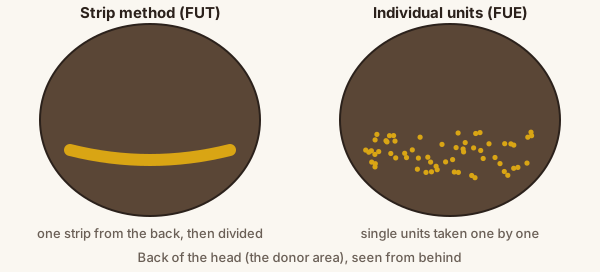
FUE and FUT compared
| FUT (strip) | FUE (individual units) | |
|---|---|---|
| How grafts are taken | One strip of donor tissue is removed and divided into grafts under microscopes 2 | Small natural clusters of 1-4 hairs are removed one at a time 1 |
| Scar | A linear scar at the back of the head 1 4 | No linear scar, but not scarless 1 |
| Short haircuts afterward | A linear scar may show with very short hair 4 | Better suited to close-cropped styles 1 4 |
| Recovery | Can involve more pain than FUE in some cases 2 | Usually faster; tiny scabs for about 1 to 2 weeks 1 |
| Shaving | Donor area not usually shaved | Donor area usually shaved; unshaved FUE takes longer and costs more 1 |
| Cost | Often lower, because it takes less surgeon labor 1 | Often higher; usually charged per graft 1 |
The ISHRS stresses that both methods result in scars, and warns about advertising that promises "scarless" surgery. 3 It also notes that FUE and FUT are only ways of harvesting; how natural the result looks depends heavily on hairline design and how the grafts are placed. 1

Who tends to be a good candidate
The ISHRS describes the ideal candidate as someone whose hair loss has been stabilized with medical therapy, who is preferably older, and who has good donor hair. 1 It says younger patients, such as those in their 20s, carry more risk because future hair loss is unpredictable. 1
Women can be candidates too, but the AAD notes that if hair is sparse all over the scalp, there may not be enough healthy donor hair. 7 Hair type matters: the ISHRS says wavier and thicker hair, and hair with low color contrast to the scalp, make results look denser. 1
A transplant doesn't stop hair loss. The ISHRS says hair loss is a dynamic process and many patients may need more than one surgery in their lifetime. 8 It says a surgeon who hasn't discussed medicine for ongoing loss may be a red flag. 2
What recovery and results look like
Cleveland Clinic says a transplant usually takes at least three weeks to recover from, and it may take up to a year to see the full result. 9 Some people need touch-up procedures. 9 The ISHRS warns that shock hair loss, a temporary shedding of the existing hair, can happen after almost any transplant and usually recovers over the following months. 2 1
Expectations matter. The AAD says a full head of hair may be unrealistic, but a fuller head of hair can be the goal. 4 Mayo Clinic says surgery for baldness isn't usually covered by insurance. 5

Questions to ask a clinic
The ISHRS publishes questions patients should ask before surgery. 3 These are the ones that matter most.
- Who will evaluate my hair loss and recommend treatment, and what is their training and experience? 3
- Who will actually perform each part of the surgery? The ISHRS says the procedure should be physician-driven, and warns about unlicensed technicians performing surgery. 1 3
- Is everyone involved covered by malpractice insurance? 3
- Which method do you suggest for me, and why? 3
- How much donor hair do I have, and how much will be left for the future? 1
- How many procedures might I need, and how long will it take? 3
- What will it cost in total, and what does that include? 3
- How will pain be managed? 3
- What about medical therapy for the hair I still have? 2
Warning signs
- Promises of "scarless" surgery or other claims the ISHRS calls exaggerated. 3
- No doctor doing the surgical work. The ISHRS links unlicensed operators to higher failure rates and overharvested donor areas, which it calls an uncorrectable problem. 1
- No discussion of whether you are a candidate. The ISHRS says a surgeon willing to tell you no, when surgery would be a bad idea, practices ethical medicine. 1
- Pressure to book quickly or a price that seems too good to be true. The ISHRS reminds patients they get what they pay for. 1
Choose a surgeon on credentials, experience and recommendations, says the ISHRS. 1 Many hair transplant surgeons are dermatologists, the AAD notes, and a dermatologist can also tell you whether you are a good candidate. 7 4

- ISHRS, “FUE Hair Transplant: Benefits, Process & Recovery”. ishrs.org/fue-what-is-it/
- ISHRS, “FUT Hair Transplant: Benefits, Procedure & Recovery”. ishrs.org/fut/
- ISHRS, “Ask your Hair Restoration Surgeon: Questions to Have Confidence Before Surgery”. ishrs.org/questions-ask-your-hair-doctor/
- American Academy of Dermatology, “A hair transplant can give you permanent, natural-looking results”. aad.org/public/diseases/hair-loss/treatment/transplant
- Mayo Clinic, “Hair loss - Diagnosis and treatment”. mayoclinic.org/diseases-conditions/hair-loss/diagnosis-treatment/drc-203
- ISHRS, “How to Find the Best Hair Transplant Surgeon”. ishrs.org/how-to-find-the-best-hair-transplant-surgeon/
- American Academy of Dermatology, “Thinning hair and hair loss: Could it be female pattern hair loss?”. aad.org/public/diseases/hair-loss/types/female-pattern
- ISHRS, “Maximizing the Donor Area in Hair Transplant Surgery”. ishrs.org/donor-area-hair-transplant/
- Cleveland Clinic, “Male Pattern Baldness (Androgenic Alopecia): Stages, Treatment”. my.clevelandclinic.org/health/diseases/24515-male-pattern-baldness-andro
General information, not medical advice. This article was drafted with AI assistance and checked against the sources listed above. Nobody at Balds is a doctor. If something here is wrong or out of date, tell us.