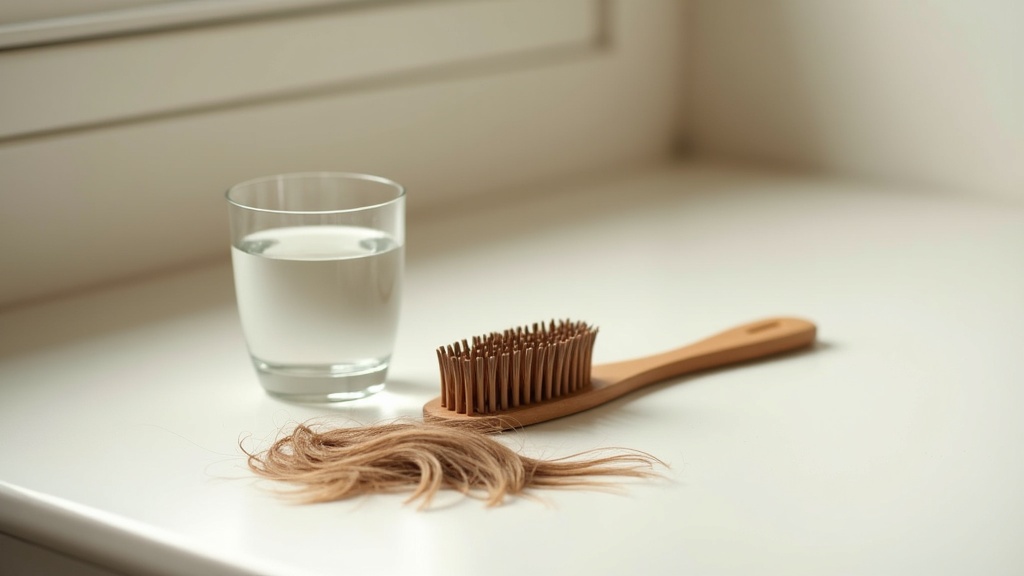
Diffuse thinning in women means the hair becomes less dense across the whole scalp rather than falling out in one obvious patch or line. The part may look wider than it used to, the scalp can show through more under bright light, and ponytails or braids feel noticeably thinner in the hand — but there’s usually no sharp bald spot and no clear border to the change.
What diffuse thinning actually looks like
Unlike a receding hairline or a single coin-sized bald patch, diffuse thinning tends to show up as an overall reduction in fullness. Common early signs include:
- A widening part line, sometimes described as a “Christmas tree” shape at the crown
- More visible scalp under overhead lighting or in photos taken from above
- A ponytail or bun that feels thinner even though the length hasn’t changed
- Hair that seems to take longer to look “full” after washing or styling
- More strands than usual on a pillow, in the shower drain, or caught in a brush
Because the change happens gradually and evenly, it’s often noticed by others, or in a photo, before the person experiencing it can pinpoint exactly when it started. That’s different from patchy hair loss, where a specific bald area appears relatively suddenly, or from a receding hairline, where the change is concentrated at the front. If you’re trying to work out which pattern you’re seeing, the types of hair loss overview breaks down how these presentations differ.

How diffuse thinning differs from other patterns
Hair loss in women doesn’t always follow the same map as it does in men. Some women do experience a pattern that concentrates around the crown or the part line, which is covered in more detail on the thinning crown page, but a genuinely diffuse pattern spreads more evenly across the top and sides of the scalp. It’s also worth distinguishing diffuse thinning from shedding — shedding refers to hair actually coming out, often after a stressor, while thinning describes the visual result of reduced density, whether that’s from shedding, reduced hair diameter, or both happening together. The hair loss in women hub is a good starting point if you want to compare this against other patterns women experience.
What tends to cause it
Diffuse thinning isn’t one condition — it’s a description of appearance that can have several underlying drivers, and more than one can be present at once. Some of the more commonly discussed causes include:
- Genetic (androgenetic) thinning — a gradual, diffuse pattern linked to genetics and hormone sensitivity in the follicles, explained further on the female pattern hair loss page
- Telogen effluvium — a temporary increase in shedding, often triggered by illness, surgery, significant weight change, or a stressful period, usually appearing a few months after the trigger; the telogen effluvium page covers how this timeline works
- Hormonal shifts, including those around perimenopause and menopause, which is discussed on the menopause and hair thinning page
- Thyroid function changes, both underactive and overactive, which can affect hair density as one of several symptoms
- Nutritional factors, including iron and other deficiencies, though diet’s role is often overstated in marketing and understated in nuance
- Medication effects, chronic illness, or recovery from a major physical event
Because so many things can produce a similar diffuse appearance, the visual pattern alone doesn’t tell you the cause. Two women can have hair that looks equally thin for entirely different reasons, and the appropriate next step depends on that underlying cause, not just on how the hair looks in the mirror. General background on this overlap is covered in the site’s causes and triggers section.
Is some shedding normal?
Yes — a certain amount of daily hair loss is expected as part of the normal growth cycle, and it’s easy to overestimate how much is “too much” once you start paying close attention. If you’re trying to judge whether what you’re seeing is within a typical range or worth tracking more carefully, the page on how much hair loss a day is normal gives some general context. Counting strands obsessively rarely settles the question on its own — a gradual change in overall density over weeks or months is usually more informative than a single bad hair day.
When to stop reading and get it looked at
Diffuse thinning that develops slowly over months is generally the kind of change that’s reasonable to observe for a while before seeking an assessment. That’s different from a few situations that warrant seeing a doctor rather than continuing to research online:
- Hair loss that happens suddenly, in clumps, or over just a few weeks
- Patchy loss with a distinct border, rather than an even, diffuse pattern
- A scalp that is painful, itchy in a persistent way, scaly, scarred, or unusually shiny
- Hair loss accompanied by other unexplained symptoms — fatigue, weight change, skin or nail changes, or irregular periods
- Any hair loss in a child
These situations matter because some causes of hair loss, particularly scarring conditions, can permanently damage the follicle if left unassessed, meaning the window for the follicle to recover narrows the longer it’s left. A website can describe patterns; it can’t examine a scalp, run bloodwork, or rule out a scarring process. If any of the above applies, a proper assessment is the right next step rather than another article — and it can help to know roughly what that visit involves, which is covered on the dermatologist hair loss visit page.
What can actually be done about it
Once a cause is identified — or at least a shortlist narrowed down — the available options generally fall into a few broad categories: topical treatments, prescription medications, procedural options, and approaches aimed at addressing an underlying trigger such as a thyroid issue or nutrient deficiency. Some treatments are prescription-only and need to be discussed directly with a prescriber, who can weigh them against a person’s specific health history; that’s not something a general article can substitute for. For a broader, non-promotional look at what categories of treatment exist and what using each one actually involves, see hair loss treatments: what categories actually exist, or browse the wider treatment options section. It’s also worth saying plainly: not everyone chooses to treat diffuse thinning, and choosing to leave it alone is just as valid an outcome as choosing to address it. There’s no single “right” response to hair changing.
Frequently asked questions about diffuse thinning in women
What does diffuse thinning look like compared to normal hair loss?
Diffuse thinning shows up as reduced overall density across the scalp — a wider part, more visible scalp under light, a thinner ponytail — rather than one bald patch. Normal daily shedding doesn’t change the overall look of the hair over time.
Can diffuse thinning in women grow back on its own?
It depends entirely on the cause, and outcomes can’t be predicted from a description alone. Some triggers resolve once the underlying issue settles, while others, like genetic thinning, tend to be gradual and ongoing rather than self-correcting.
Is diffuse thinning the same as female pattern hair loss?
Not always. Female pattern hair loss is one specific, genetically linked cause of diffuse thinning, but shedding from stress, illness, hormones, or thyroid changes can produce a similar visual pattern without being the same underlying condition.
How do I know if my hair thinning is serious?
Gradual, even thinning over months is generally not an emergency, but sudden loss, patchy bald spots, a painful or scaly scalp, or thinning alongside other unexplained symptoms are reasons to see a doctor rather than keep monitoring it alone.
Does stress cause diffuse thinning in women?
Significant physical or emotional stress can trigger a temporary shedding phase that shows up as diffuse thinning a few months later, though it’s one of several possible causes and not the explanation for every case.
Balds publishes general educational information about hair loss, not medical advice. We are writers, not doctors or dermatologists. If your hair loss is sudden, patchy, painful, or comes with other unexplained symptoms, see a doctor or a dermatologist — some forms of hair loss can become permanent without early assessment.