A dermatologist starts with questions about how long you've had the loss and how fast it came on, looks closely at your scalp and nails, and gently pulls on your hair to see how it is growing. 1 Blood tests or a scalp biopsy are added if a disease, deficiency, hormone problem or infection is suspected. 1 Bring a timeline, your medicines and supplements, and photos. 2 3
Hair loss has many causes, and they can look alike. The American Academy of Dermatology says effective treatment begins with finding the cause, and that a board-certified dermatologist is the doctor with in-depth knowledge of the many causes. 1
This guide explains what usually happens at the appointment, and how to prepare so you leave with an answer rather than more questions.
GP or dermatologist?
Either is a reasonable start. The NHS says a GP may be able to tell what is causing hair loss by looking at your hair, and suggests seeing a GP before going to a commercial hair clinic. 4 DermNet notes that a GP can do a medical workup and refer you to a dermatologist. 5
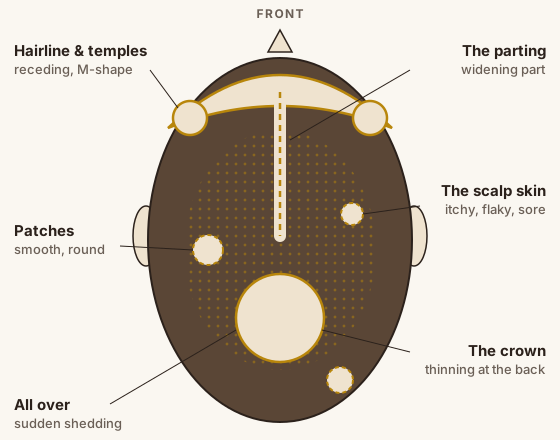
Go straight to a dermatologist, or ask for an urgent referral, if you have patches, a sore or scaly scalp, a receding hairline in a woman, or signs of scarring. Those causes do better when treated early. 6 7 Cleveland Clinic advises choosing a dermatologist with a lot of hair loss experience when scarring is possible. 8

The questions you will be asked
The AAD says a dermatologist will ask how long you've had hair loss and whether it came on quickly. 1 MedlinePlus lists the other topics a provider covers. 3
- the pattern of the loss, whether hair is lost elsewhere on the body, and family history; 3
- how you care for your hair: shampoo, blow-drying and products; 3
- stress and emotional well-being; 3
- diet and recent changes; 3
- recent illnesses, high fevers and surgery. 3
Medicines matter too. DermNet says a drug history should focus on the three months before the hair loss was noticed, including dose changes and supplements. 2
The examination
The AAD says the dermatologist will look closely at your scalp, your nails and any other area with hair loss. 1 Nails can give clues: pitting is seen in alopecia areata, for example. 9
- A close look with a scope. Dermatologists often use a magnifying device. DermNet says this kind of exam, called trichoscopy, can help tell scarring from non-scarring hair loss and early pattern loss from shedding. 10
- A pull test. The AAD says gently pulling on your hair shows how it is growing and whether it breaks easily. 1 Cleveland Clinic explains that a clump of 40 to 60 hairs normally releases only two to three; more suggests shedding. 11
- Measuring thickness. Cleveland Clinic says a provider may use a densitometer to look at the thickness of hairs. 12
Tests
Many people need no tests. MedlinePlus says a careful history and examination are usually enough, and tests are rarely needed. 3 When they are, the AAD says blood tests or a scalp biopsy can be done if the cause could be a disease, vitamin deficiency, hormone imbalance or infection. 1
| Test | What it looks for |
|---|---|
| Blood count and iron studies | Anemia and low iron stores 2 13 |
| Thyroid function | An underactive or overactive thyroid 14 2 |
| Sex hormones | Excess androgens, especially with acne or irregular periods 5 |
| Skin scrapings or hair clippings | A fungal infection such as scalp ringworm 14 |
| Scalp biopsy | Scarring conditions, and telling pattern loss from chronic shedding 8 15 |
Tell the doctor if you take biotin. The NIH Office of Dietary Supplements says it can interfere with some lab tests, including hormone tests such as thyroid tests, and give false results. 16
What to bring: a checklist
- A timeline. When you first noticed the loss, and whether it was sudden or gradual. 1
- Events from the months before: illness, fever, surgery, a birth, a diet, major stress. Shedding often follows a trigger by a few months. 17
- Every medicine and supplement, with start dates and dose changes. 2
- Photos of your part, hairline or crown, taken months apart in similar light.
- Family history of hair loss on both sides. 3
- Other symptoms: itching, burning, tiredness, feeling cold, weight change, acne or irregular periods. 3 18
Questions worth asking
- What do you think is causing it, and is more than one thing going on? The AAD notes that some people have more than one cause, such as shedding after a birth on top of early hereditary loss. 1
- Is this likely to regrow on its own? The AAD says hair may regrow without treatment after a major illness or surgery, or with mild alopecia areata. 1
- If I treat it, how long before we know whether it is working, and what happens if I stop?
- Is any of this urgent, or is it fine to take time to decide?
The AAD says no single hair loss treatment works for everyone. 1 Our guide to what each option involves helps you follow the discussion.

- American Academy of Dermatology, “Hair loss: Diagnosis and treatment”. aad.org/public/diseases/hair-loss/treatment/diagnosis-treat
- DermNet, “Alopecia from drugs”. dermnetnz.org/topics/alopecia-from-drugs
- MedlinePlus (NIH), “Hair loss: MedlinePlus Medical Encyclopedia”. medlineplus.gov/ency/article/003246.htm
- NHS, “Hair loss”. nhs.uk/symptoms/hair-loss/
- DermNet, “Female pattern hair loss”. dermnetnz.org/topics/female-pattern-hair-loss
- American Academy of Dermatology, “Hair loss types: Frontal fibrosing alopecia overview”. aad.org/public/diseases/hair-loss/types/frontal-fibrosing-alopecia
- American Academy of Dermatology, “Hair loss types: Central centrifugal cicatricial alopecia overview”. aad.org/public/diseases/hair-loss/types/ccca
- Cleveland Clinic, “Scarring (Cicatricial) Alopecia: What It Looks Like & Treatment”. my.clevelandclinic.org/health/diseases/24582-scarring-alopecia
- NIAMS (NIH), “Alopecia Areata–Hair Loss Symptoms, Types, & Causes”. niams.nih.gov/health-topics/alopecia-areata
- DermNet, “Trichoscopy: A Complete Overview — DermNet”. dermnetnz.org/topics/trichoscopy
- Cleveland Clinic, “Telogen Effluvium: Symptoms, Causes, Treatment & Regrowth”. my.clevelandclinic.org/health/diseases/24486-telogen-effluvium
- Cleveland Clinic, “Male Pattern Baldness (Androgenic Alopecia): Stages, Treatment”. my.clevelandclinic.org/health/diseases/24515-male-pattern-baldness-andro
- Mayo Clinic, “Iron deficiency anemia - Symptoms & causes”. mayoclinic.org/diseases-conditions/iron-deficiency-anemia/symptoms-cause
- DermNet, “Hair loss, balding, hair shedding, alopecia”. dermnetnz.org/topics/hair-loss
- Dinh & Sinclair, Clin Interv Aging (PMC), “Female pattern hair loss: Current treatment concepts - PMC”. pmc.ncbi.nlm.nih.gov/articles/PMC2684510/
- NIH Office of Dietary Supplements, “Biotin - Health Professional Fact Sheet”. ods.od.nih.gov/factsheets/Biotin-HealthProfessional/
- American Academy of Dermatology, “Do you have hair loss or hair shedding?”. aad.org/public/diseases/hair-loss/insider/shedding
- American Academy of Dermatology, “Hair loss: Signs and symptoms”. aad.org/public/diseases/hair-loss/insider/begin
- Mayo Clinic, “Hair loss - Symptoms and causes”. mayoclinic.org/diseases-conditions/hair-loss/symptoms-causes/syc-2037292
General information, not medical advice. This article was drafted with AI assistance and checked against the sources listed above. Nobody at Balds is a doctor. If something here is wrong or out of date, tell us.