Female pattern hair loss is the most common cause of hair loss in women. 1 It thins the hair over the top of the scalp and widens the part, while the front hairline usually stays in place. 2 3 It is inherited from either parent and becomes more common after menopause. 1 4 It tends to progress slowly, and treatment works best when started at the first sign. 1
For many women, it starts with something small. The part looks a little wider in the mirror. A ponytail feels thinner in the hand. The scalp shows under bright light where it didn't before. The American Academy of Dermatology says a widening part or a thinner ponytail is often the first sign. 5
Female pattern hair loss is the most common cause of hair loss in women, according to the AAD. 1 It is also widely misunderstood, partly because it looks so different from the balding pattern most people picture.
What it looks like
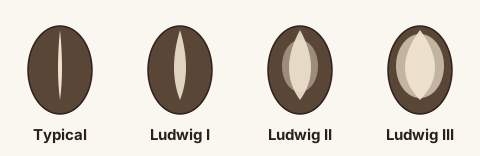
The defining feature is the pattern. A review in Clinical Interventions in Aging describes diffuse thinning over the mid-front scalp with the front hairline largely spared. 3 The thinning is easiest to see when the hair is parted down the middle. 3
MedlinePlus Genetics puts it simply: in women the hair becomes thinner on top of the head, the middle part widens, and the hairline does not typically recede. 2 It rarely leads to total baldness. 2 The AAD adds that hair near the temples may recede in some women, and that without treatment some develop widespread thinning. 1
Dermatologists sometimes describe a "Christmas tree" shape. When the hair is parted in the middle, density falls off toward the front, so the exposed scalp widens like a tree. 3 6
How common it is, by age
Very common, and more so with age. The figures below come from an Australian population study summarized in the same review. 3
| Age | Women with detectable female pattern hair loss |
|---|---|
| by 29 | 12% 3 |
| by 49 | 25% 3 |
| by 69 | 41% 3 |
| by 79 | over 50% have some element of it 3 |
MedlinePlus Genetics estimates that androgenetic alopecia affects 30 million women in the United States. 2 The AAD says it usually begins in the 40s, 50s or 60s, though it can start earlier. 1 Severe loss is uncommon. The same review says severe loss, Ludwig grade III, affects less than 1% of women. 3

What causes it
It is hereditary. The AAD says you inherit the genes from your mother, your father or both. 1 DermNet says many genes contribute, and that genetic testing to predict it is unreliable. 4
Hormones play a part, but less clearly than in men. DermNet notes that it is not clear whether androgens play a role, and that most women with it have normal androgen levels in their blood. 4 That is why doctors prefer the term female pattern hair loss over female androgenetic alopecia. 4 3 MedlinePlus Genetics says androgens play a role in female pattern hair loss, but other factors that are not yet known are also involved. 2
Menopause matters. The AAD says it is more common after menopause, so hormones may also play a role. 1 DermNet notes the role of estrogen is uncertain. 4 Our guide to menopause and hair thinning covers this stage.
In a minority of women there is an underlying hormone excess. DermNet says these women also tend to have acne, irregular periods and excess facial and body hair, features of polycystic ovary syndrome. 4 That combination is worth telling a doctor about.
How it progresses
It is slow and uneven. DermNet says the loss is not constant and often comes in bursts. It is common to have faster phases of loss for 3–6 months, followed by stable periods lasting 6–18 months. 4 Without treatment, it tends to become more severe over the following decades. 4
The AAD calls it a progressive condition: women tend to keep losing hair, but they do not lose all of it, as some men do. 1 That pattern of bursts and pauses is one reason photos taken months apart are more useful than daily checking.
How it is diagnosed
The AAD says the best step is to see a dermatologist, because other causes of hair loss can look like female pattern hair loss and need different treatment. 1 The most common lookalike is shedding. Increased shedding is common in the early stages of female pattern hair loss. 3 Doctors also consider acute and chronic telogen effluvium, where hair sheds heavily all over. 3 4
A doctor usually diagnoses it by looking at the scalp and taking a history. 3 DermNet says blood tests may include sex hormones and thyroid function. 4 Sometimes a scalp biopsy is needed to confirm it. 4 Our guide to diffuse thinning in women covers the other causes.

It is more than cosmetic
The emotional weight is real. DermNet says studies show women with this kind of hair loss have a more negative body image and find daily functioning harder than unaffected women. 4 The review notes one study where 52% of women were very to extremely upset by their hair loss, compared with 28% of men. 3 Part of the reason, the authors suggest, is that hair loss in women is less expected and less understood. 3
The NHS says a GP may be able to help arrange counseling if hair loss is causing distress, and suggests support groups. 7
What the options involve
Balds doesn't rank treatments or promise results. Here is what the American Academy of Dermatology says each involves. 1
- Minoxidil. Applied to the scalp and available without a prescription. It is FDA-approved for women. 1 The AAD says it takes about six to 12 months of continuous use to know how well it works, and the benefit is lost if you stop. 1 Shedding may increase for the first two to eight weeks. 1 It should be avoided in pregnancy and while breastfeeding. 1
- Prescription pills. Dermatologists may prescribe medicines such as spironolactone, which are FDA-approved for other conditions but not for female pattern hair loss. 1 The AAD says these are not an option during pregnancy or when planning one, because they may cause birth defects. 1
- Hair transplants. An option for some women, but not for those whose hair is sparse all over, since the donor hair may be too thin. 1 3
- Newer options. Home laser devices and platelet-rich plasma are available, but the AAD says more studies are needed on safety and long-term effect. 1
- Supplements and shampoos. The AAD says that in most studies, supplements had no effect on hair growth and thickness, and that hair loss shampoos cannot regrow hair or stop loss worsening. 1
Treatment works best when started at the first sign of loss, says the AAD. 1 DermNet stresses managing expectations: the main aim is to slow or stop progression, and results vary. 4
Questions worth taking to an appointment
An appointment goes further when you arrive with a short history and a few questions. These come straight from what the sources above say matters.
- Is this pattern hair loss, shedding, or both? Shedding is common early on, and telogen effluvium can look similar, so the answer changes the plan. 3
- Do I need blood tests? DermNet lists sex hormones and thyroid function as part of the usual workup. 4 Mention acne, irregular periods or extra facial hair if you have them. 4
- How will we know if a treatment is working? The AAD says it can take six to 12 months to tell. 1 Agree on photos or a scale to judge by, such as the part-width grades described in our widening part guide.
- What happens if I stop? With minoxidil and the prescription pills, the AAD says the benefit is lost after stopping. 1
- Does this fit with pregnancy plans? Several options are ruled out during pregnancy or breastfeeding, so say if this applies. 1
Bring a list of every medicine and supplement you take. Some can interact with treatment, and some can cause shedding of their own. 1 8
Styling and camouflage
Many women manage the look of thinning without medicine, or alongside it. The review lists styling, camouflage products, hair pieces and accessories as part of good care. 3 It suggests more lift from shorter styles, a side or zigzag part to soften the central thinning, and soft layers on top. 3 DermNet mentions colored sprays and hair-building fiber powders. 4 Our guide to styling thinning hair goes into detail.

- American Academy of Dermatology, “Thinning hair and hair loss: Could it be female pattern hair loss?”. aad.org/public/diseases/hair-loss/types/female-pattern
- MedlinePlus Genetics (NIH), “Androgenetic alopecia: MedlinePlus Genetics”. medlineplus.gov/genetics/condition/androgenetic-alopecia/
- Dinh & Sinclair, Clin Interv Aging (PMC), “Female pattern hair loss: Current treatment concepts - PMC”. pmc.ncbi.nlm.nih.gov/articles/PMC2684510/
- DermNet, “Female pattern hair loss”. dermnetnz.org/topics/female-pattern-hair-loss
- American Academy of Dermatology, “Hair loss: Signs and symptoms”. aad.org/public/diseases/hair-loss/insider/begin
- Gupta & Mysore, J Cutan Aesthet Surg (PMC), “Classifications of Patterned Hair Loss: A Review - PMC”. pmc.ncbi.nlm.nih.gov/articles/PMC4812885/
- NHS, “Hair loss”. nhs.uk/symptoms/hair-loss/
- DermNet, “Alopecia from drugs”. dermnetnz.org/topics/alopecia-from-drugs
- Mayo Clinic, “Hair loss - Symptoms and causes”. mayoclinic.org/diseases-conditions/hair-loss/symptoms-causes/syc-2037292
General information, not medical advice. This article was drafted with AI assistance and checked against the sources listed above. Nobody at Balds is a doctor. If something here is wrong or out of date, tell us.