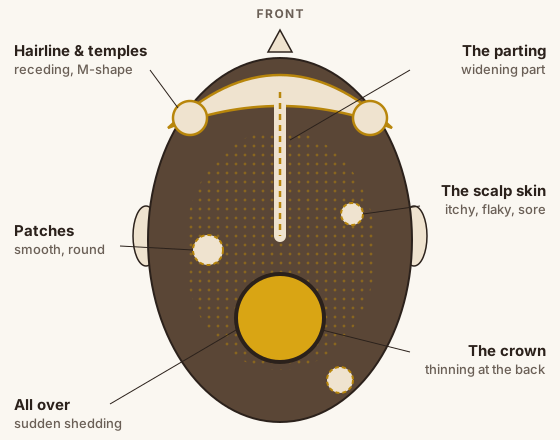
A thinning crown is most often pattern hair loss, the inherited, gradual thinning that affects both sexes. 1 2 In men the crown is one of the two classic areas, with the hairline. 1 In women, thinning on top usually shows as a widening part. 3 Sudden shedding, tight styles and scalp conditions can look similar, so if it is changing fast, patchy or sore, have it checked. 2 4
The crown is the hardest part of your own head to see. Many people first hear about a thin spot there from a barber, or spot it in a photo taken from above. That surprise can make it feel sudden, even when it has been building slowly for years.
This guide covers what usually causes crown thinning, what else can look like it, and how to keep track without obsessing.
Where the crown is
The crown, or vertex, is the back-top of the head, where the hair usually swirls out from a center point. It is one of the two areas pattern hair loss most often reaches in men, with the hairline at the temples. 1 The swirl itself can make the scalp show a little at the center. That is normal and not a sign of loss on its own.
Crown thinning in men
In male pattern hair loss, MedlinePlus Genetics says the hair thins at the top of the head, often progressing to partial or complete baldness, as the hairline recedes at the temples. 1 Cleveland Clinic describes crown loss as usually appearing in a circular shape. 5
On the Norwood scale, crown loss appears at stage 4. At stage 5 the receding front connects to the bald spot on the crown. 5 Some men notice the crown before any change at the front. Our guide to the Norwood scale walks through every stage.
The cause is an inherited sensitivity to the hormone DHT in some scalp follicles. 6 Over time those follicles grow shorter, finer hairs. 6 That is why crown thinning usually looks like a gradual loss of density rather than hairs falling out in clumps.
Crown and top thinning in women
Women's pattern hair loss looks different. MedlinePlus Genetics says the hair becomes thinner on top of the head, the middle part widens, and the hairline does not usually recede. 1 The American Academy of Dermatology says the first sign for many women is a widening part or less fullness in a ponytail. 4
So a woman may describe it as "my crown is thin" when the change runs along the whole top of the head. The AAD says female pattern hair loss most often begins in the 40s, 50s or 60s, though it can start earlier. 3 Our guides to female pattern hair loss and the widening part go further.
Other causes that can look like it
Pattern hair loss is the most common cause, but not the only one. The American Academy of Dermatology notes that other causes can look like female pattern hair loss, so ruling them out matters. 3 The same applies to men.
| Cause | What tends to be different |
|---|---|
| Sudden shedding (telogen effluvium) | Hair comes out all over, often in handfuls, a few months after an illness or shock. Usually temporary. 2 7 |
| Alopecia areata | Round or patchy bald spots, sometimes with itching or pain first. 2 |
| Scalp ringworm | Scaly patches that spread, with broken hair, redness or swelling. 2 |
| Scarring hair loss | Inflammation that can destroy follicles, sometimes with itching, burning or tenderness. 4 8 |
| Central centrifugal cicatricial alopecia (CCCA) | A scarring loss that often begins as a small round patch in the center of the scalp and grows. More common in Black women, but it affects men and people of all races too. 9 |
The last row deserves attention. The American Academy of Dermatology says CCCA destroys hair follicles and can cause permanent hair loss, and that starting treatment early can stop it spreading. 9 Crown thinning with itching, tenderness or burning is a reason to see a dermatologist rather than wait. Our guide to scarring hair loss explains why.

How to tell if it is actually changing
Crown thinning is hard to judge by eye, and bathroom lighting makes it worse. A simple routine gives better answers.
- Photograph it the same way each time. Same room, same light, hair dry and styled the same, camera held at the same height.
- Space the photos out. Pattern loss is slow. Comparing photos a few months apart shows real change. Comparing yesterday to today mostly shows lighting.
- Watch for shedding separately. More hair in the brush is a different signal from less density at the crown. Normal shedding is about 50 to 100 hairs a day. 7
- Note anything else. Itching, soreness, flaking or patches change the picture. 4
A doctor uses similar information. Cleveland Clinic says a provider asks when you noticed the loss and about family history, and looks at the pattern. 5 Your photos give them a timeline.
When to stop watching and get it checked
Gradual crown thinning with no other symptoms is not urgent. Seeing a doctor is still worthwhile if it bothers you or you want to consider treatment. The American Academy of Dermatology says treatment for pattern hair loss tends to work best when started early. 3 10
What doing something about it involves
For pattern hair loss, the American Academy of Dermatology lists FDA-approved minoxidil, which is applied to the scalp, and for men, prescription finasteride. 10 3 Both only help while they are used. 10 Hair transplants are another route for some people. 10 Our guide to what each option involves covers the details without ranking them.
Some people choose to do nothing at all. Mayo Clinic notes that some people let hair loss run its course untreated and unhidden, while others cover it with hairstyles, hats or scarves. 2 All of these are reasonable choices.
- MedlinePlus Genetics (NIH), “Androgenetic alopecia: MedlinePlus Genetics”. medlineplus.gov/genetics/condition/androgenetic-alopecia/
- Mayo Clinic, “Hair loss - Symptoms and causes”. mayoclinic.org/diseases-conditions/hair-loss/symptoms-causes/syc-2037292
- American Academy of Dermatology, “Thinning hair and hair loss: Could it be female pattern hair loss?”. aad.org/public/diseases/hair-loss/types/female-pattern
- American Academy of Dermatology, “Hair loss: Signs and symptoms”. aad.org/public/diseases/hair-loss/insider/begin
- Cleveland Clinic, “Male Pattern Baldness (Androgenic Alopecia): Stages, Treatment”. my.clevelandclinic.org/health/diseases/24515-male-pattern-baldness-andro
- DermNet, “Male pattern hair loss (androgenetic alopecia, balding)”. dermnetnz.org/topics/male-pattern-hair-loss
- American Academy of Dermatology, “Do you have hair loss or hair shedding?”. aad.org/public/diseases/hair-loss/insider/shedding
- Cleveland Clinic, “Scarring (Cicatricial) Alopecia: What It Looks Like & Treatment”. my.clevelandclinic.org/health/diseases/24582-scarring-alopecia
- American Academy of Dermatology, “Hair loss types: Central centrifugal cicatricial alopecia overview”. aad.org/public/diseases/hair-loss/types/ccca
- American Academy of Dermatology, “What is male pattern hair loss, and can it be treated?”. aad.org/public/diseases/hair-loss/treatment/male-pattern-hair-loss-treat
General information, not medical advice. This article was drafted with AI assistance and checked against the sources listed above. Nobody at Balds is a doctor. If something here is wrong or out of date, tell us.