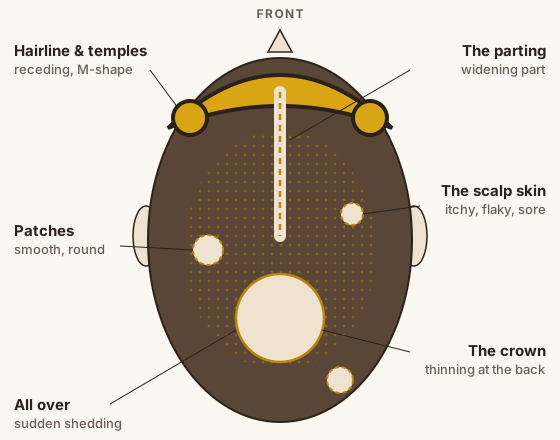
Female pattern hair loss becomes more common after menopause, so hormones may play a role, though the exact part estrogen plays is uncertain. 1 2 It thins the top and widens the part while the hairline stays. 3 A receding band along the front and sides, often with thinning eyebrows, is different: it can be frontal fibrosing alopecia, which is usually diagnosed after menopause and needs early treatment. 4
Hair often changes in midlife. Many women notice their part getting wider, their hair losing volume, or more hair in the brush in the years around menopause. Sometimes that is the start of pattern hair loss. Sometimes it is shedding. Occasionally it is a condition that needs prompt attention.
This guide sorts out which is which.
Pattern hair loss becomes more common
The American Academy of Dermatology says female pattern hair loss is more common after menopause, so hormones may play a role. 1 MedlinePlus Genetics says hair loss in women is most likely after menopause. 3 DermNet agrees that it occurs more often after menopause. 2
The role of estrogen is not settled. DermNet notes that the rise after menopause suggests estrogens may support hair growth, but laboratory work has also suggested they may suppress it. 2 What is clear is the pattern. The hair on top thins and the middle part widens, while the front hairline usually stays. 3 It rarely leads to total baldness. 3
It tends to come in waves. DermNet says faster phases of loss lasting 3–6 months are often followed by stable periods of 6–18 months. 2 Our guide to female pattern hair loss covers it in full.
Shedding can happen too
Not every midlife change is pattern loss. MedlinePlus says hair loss from menopause or childbirth often goes away after 6 months to 2 years. 5 It also describes some women aged 30 to 60 who notice thinning across the whole scalp, heavier at first and then slowing or stopping, with no known cause. 5
Midlife brings other triggers for shedding as well: illness, surgery, new medicines and stress. 6 5 Thyroid problems become more common with age too, and the NHS lists dry hair or hair loss among the symptoms of an underactive thyroid. 7
A hairline that recedes: check for FFA
One condition is closely tied to menopause and is easy to miss. Frontal fibrosing alopecia, or FFA, is usually diagnosed in women after menopause. 4 The American Academy of Dermatology says most notice hair loss about two to 12 years after menopause starts. 4
It looks different from pattern loss:
- a receding hairline along the front and sides, often a thin band of balding skin; 4
- loss of eyebrow hair, often the first sign; between 80% and 95% of women diagnosed have lost some or all of their eyebrows; 4
- sometimes loss of hair elsewhere on the body. 4
FFA destroys hair follicles and causes permanent hair loss. 4 The AAD says early diagnosis and treatment from a dermatologist can stop it progressing. 4 Mayo Clinic also advises women with a receding hairline to ask about early treatment to avoid significant permanent baldness. 8 If your hairline is moving back or your eyebrows are thinning, book an appointment rather than waiting to see.
What a doctor may check
DermNet says blood tests for women with thinning hair can include sex hormones and thyroid function. 2 A doctor will look at the pattern, ask about medicines and supplements, and look at the hairline and eyebrows. 9 For FFA or other scarring conditions, a scalp biopsy may be needed. 10
What the options involve
For pattern hair loss, the American Academy of Dermatology lists minoxidil as FDA-approved for women and the most recommended treatment. 1 It takes six to 12 months to judge, and the benefit fades if you stop. 1 Dermatologists may also prescribe pills such as spironolactone, which are not FDA-approved for hair loss but are used for it. 1 Some women are suitable for a hair transplant, though not if the hair is thin all over. 1
Menopausal hormone therapy is sometimes asked about. The sources here do not recommend it as a hair treatment, and DermNet notes the role of estrogen is uncertain. 2 It is a question for your doctor, weighed against everything else hormone therapy involves.

If it is getting to you
Hair loss can land hard in midlife, on top of everything else that is changing. A published review notes that hair loss in women tends to cause more distress than in men, partly because it is less expected and less understood. 9 It also describes the ways women cope, from concealment to finding a style that works. 9 The NHS says a GP may be able to arrange counseling if hair loss is causing distress, and points to support groups. 11 Talking about it is a reasonable thing to do.
Day-to-day care
Thinning hair breaks more easily. The AAD suggests a gentle shampoo, conditioner after every wash, a microfiber towel, the lowest heat setting and no tight styles. 12 It also says too much selenium, vitamin A or vitamin E has been linked to hair loss, so check before adding supplements. 12
Styling can make a big difference to how thinning looks. A published review suggests more lift from shorter styles, a side or zigzag part and soft layers on top. 9 Our guide to styling thinning hair has more ideas.

- American Academy of Dermatology, “Thinning hair and hair loss: Could it be female pattern hair loss?”. aad.org/public/diseases/hair-loss/types/female-pattern
- DermNet, “Female pattern hair loss”. dermnetnz.org/topics/female-pattern-hair-loss
- MedlinePlus Genetics (NIH), “Androgenetic alopecia: MedlinePlus Genetics”. medlineplus.gov/genetics/condition/androgenetic-alopecia/
- American Academy of Dermatology, “Hair loss types: Frontal fibrosing alopecia overview”. aad.org/public/diseases/hair-loss/types/frontal-fibrosing-alopecia
- MedlinePlus (NIH), “Hair loss: MedlinePlus Medical Encyclopedia”. medlineplus.gov/ency/article/003246.htm
- American Academy of Dermatology, “Do you have hair loss or hair shedding?”. aad.org/public/diseases/hair-loss/insider/shedding
- NHS, “Underactive thyroid (hypothyroidism)”. nhs.uk/conditions/underactive-thyroid-hypothyroidism/
- Mayo Clinic, “Hair loss - Symptoms and causes”. mayoclinic.org/diseases-conditions/hair-loss/symptoms-causes/syc-2037292
- Dinh & Sinclair, Clin Interv Aging (PMC), “Female pattern hair loss: Current treatment concepts - PMC”. pmc.ncbi.nlm.nih.gov/articles/PMC2684510/
- Cleveland Clinic, “Scarring (Cicatricial) Alopecia: What It Looks Like & Treatment”. my.clevelandclinic.org/health/diseases/24582-scarring-alopecia
- NHS, “Hair loss”. nhs.uk/symptoms/hair-loss/
- American Academy of Dermatology, “Hair loss: Tips for managing”. aad.org/public/diseases/hair-loss/treatment/tips
- American Academy of Dermatology, “Hair loss: Signs and symptoms”. aad.org/public/diseases/hair-loss/insider/begin
General information, not medical advice. This article was drafted with AI assistance and checked against the sources listed above. Nobody at Balds is a doctor. If something here is wrong or out of date, tell us.