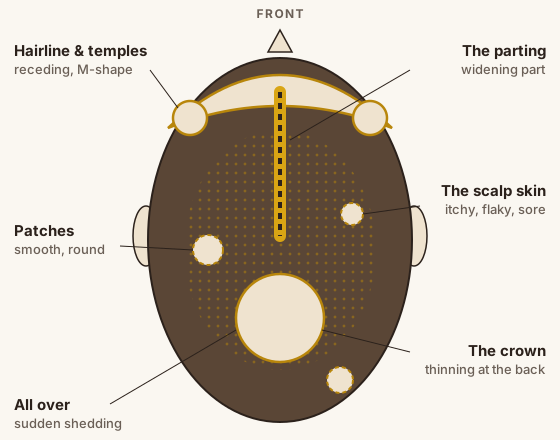
A widening part is often the first sign of female pattern hair loss, the most common cause of hair loss in women. 1 2 Doctors grade it by looking straight down at a middle part: on the Sinclair scale, grade 2 is a wider central part and grade 3 adds thinning on either side. 3 Heavy shedding after an illness, a birth or stress can look similar, so it is worth getting a diagnosis. 3 2
The part is where thinning on top of the head shows first. Hair falls away on either side of it, so any loss of density shows up as more visible scalp. That makes the part a useful early warning, and also a common source of worry on a bad-light day.
This guide covers what a widening part usually means, how to check it fairly, and what else can cause it.
What it usually means
The American Academy of Dermatology says that for women, the first noticeable sign of hair loss is often a widening part or less fullness in a ponytail. 1 It also says female pattern hair loss is the most common cause of hair loss in women. 2
In female pattern hair loss, hair thins over the top of the scalp while the front hairline usually stays. 4 A published review describes a widening of the central part with a diffuse loss of density over the front of the scalp, rather than baldness. 3 That is exactly what a wider part looks like day to day.
Men can see a wider part too, though in male pattern loss the changes usually start at the temples and crown. 4
How to check it fairly
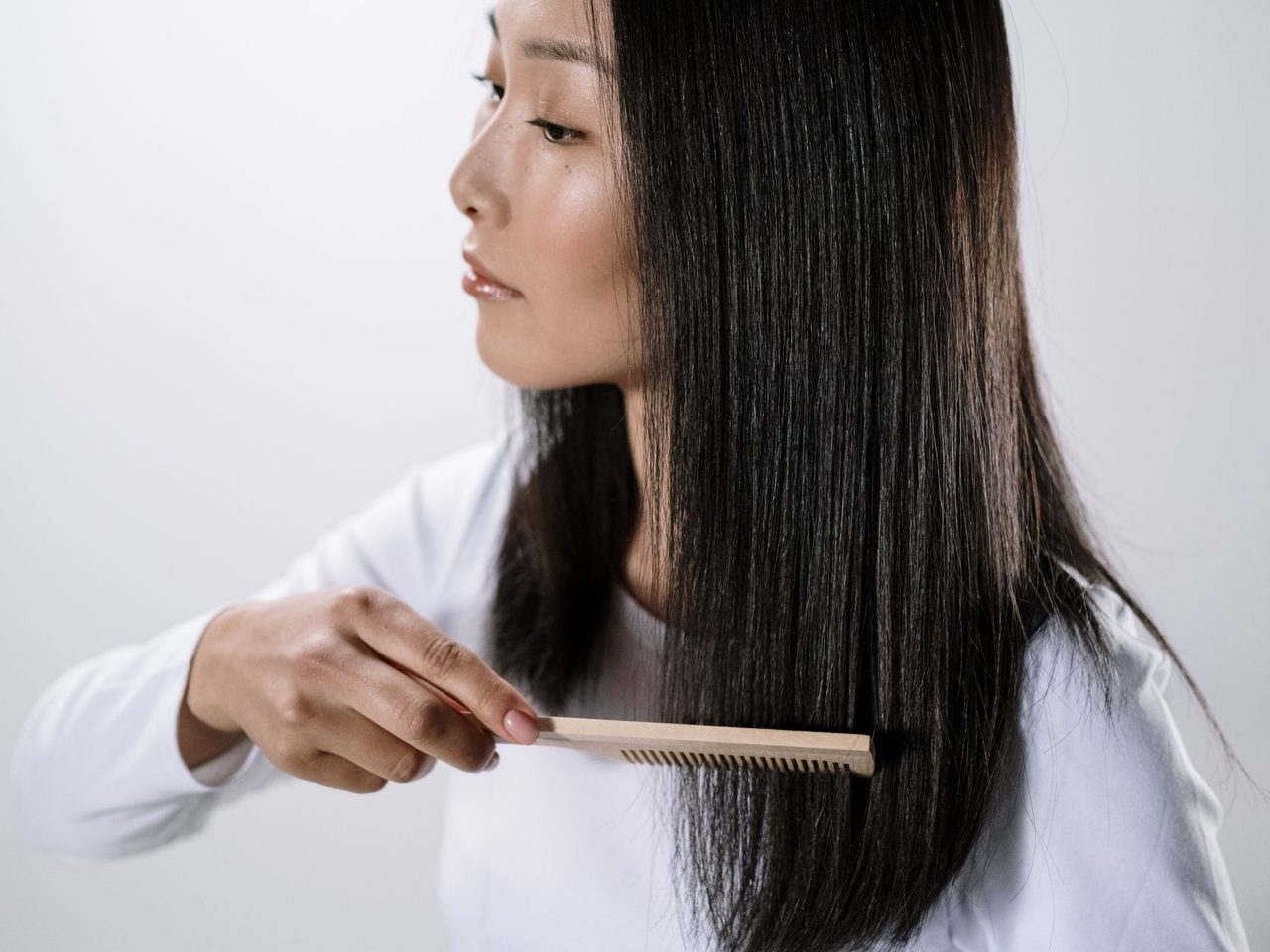
Doctors use the part itself as a measure. The Sinclair scale grades female pattern hair loss by looking at a middle part. 3 You can borrow the idea at home.
- Part the hair down the middle with a comb, from the front hairline toward the crown.
- Photograph from directly above, in daylight from a window, with the camera at the same height each time.
- Compare the width at the front with the width further back. A gradual widening toward the front is the typical "Christmas tree" shape described in female pattern hair loss. 3
- Repeat every few months. DermNet notes that this kind of loss often comes in bursts of 3–6 months, then pauses for 6–18 months. 5 Frequent checks catch noise, not trends.
| Sinclair grade | What the part looks like |
|---|---|
| 1 | Normal. 3 |
| 2 | A widening of the central part. 3 |
| 3 | A widening of the central part and thinning on either side of it. 3 |
| 4 | Diffuse hair loss emerging over the top of the scalp. 3 |
| 5 | Advanced hair loss. 3 |
Other causes of a wider part
A wider part is not always pattern hair loss. The AAD stresses that other causes can look like it and need different treatment. 2
- Shedding (telogen effluvium). Heavy shedding all over the scalp, often a few months after illness, surgery, a birth or a crash diet, thins the hair everywhere, including at the part. 3 7 It is usually temporary.
- Thyroid problems. The AAD notes that thyroid problems can cause thinning hair. 8
- Low iron or poor nutrition. The AAD says not getting enough iron or protein can lead to hair loss. 9
- Styling habits. Always parting in the same spot, tight styles and heat can thin and break hair along the line. 10
Often more than one is going on. Women with early pattern loss often notice heavier shedding before they notice a wider part. 3 That is why a proper diagnosis helps.
Life events count too. The AAD says new mothers often see heavy shedding a few months after giving birth, and that it usually settles. 11 A wider part that appears after a birth, an illness or a big diet change may be shedding rather than pattern loss.
What a doctor will check
Diagnosis is usually based on the pattern and your history. 3 DermNet says blood tests may include sex hormones and thyroid function. 5 A doctor will also ask about acne, irregular periods and extra facial or body hair, since that combination can point to excess androgens. 5
Bring your part photos. A series taken months apart shows the doctor how fast things are moving. Our guide to the hair loss appointment lists what else to bring.
Making the part less obvious
Whatever the cause, a few styling changes soften a wide part. The review lists a side or zigzag part to disguise central thinning, and soft layers on top. 3 DermNet mentions colored hair sprays and hair-building fibers. 5 Changing where you part your hair now and then also spreads the wear. Our guide to styling thinning hair has more.
What to do next
If your part has widened over months and you have no other symptoms, it is reasonable to book an ordinary appointment rather than an urgent one. The AAD says treatment for female pattern hair loss delivers the best results when started at the first sign. 2 Our guide to female pattern hair loss covers what the options involve.
- American Academy of Dermatology, “Hair loss: Signs and symptoms”. aad.org/public/diseases/hair-loss/insider/begin
- American Academy of Dermatology, “Thinning hair and hair loss: Could it be female pattern hair loss?”. aad.org/public/diseases/hair-loss/types/female-pattern
- Dinh & Sinclair, Clin Interv Aging (PMC), “Female pattern hair loss: Current treatment concepts - PMC”. pmc.ncbi.nlm.nih.gov/articles/PMC2684510/
- MedlinePlus Genetics (NIH), “Androgenetic alopecia: MedlinePlus Genetics”. medlineplus.gov/genetics/condition/androgenetic-alopecia/
- DermNet, “Female pattern hair loss”. dermnetnz.org/topics/female-pattern-hair-loss
- Gupta & Mysore, J Cutan Aesthet Surg (PMC), “Classifications of Patterned Hair Loss: A Review - PMC”. pmc.ncbi.nlm.nih.gov/articles/PMC4812885/
- American Academy of Dermatology, “Do you have hair loss or hair shedding?”. aad.org/public/diseases/hair-loss/insider/shedding
- American Academy of Dermatology, “Hair loss: Who gets and causes”. aad.org/public/diseases/hair-loss/causes/18-causes
- American Academy of Dermatology, “Hair loss: Tips for managing”. aad.org/public/diseases/hair-loss/treatment/tips
- American Academy of Dermatology, “How to stop damaging your hair”. aad.org/public/diseases/hair-loss/insider/stop-damage
- American Academy of Dermatology, “Hair loss in new moms: Dermatologist tips”. aad.org/public/diseases/hair-loss/insider/new-moms
- Mayo Clinic, “Hair loss - Symptoms and causes”. mayoclinic.org/diseases-conditions/hair-loss/symptoms-causes/syc-2037292
General information, not medical advice. This article was drafted with AI assistance and checked against the sources listed above. Nobody at Balds is a doctor. If something here is wrong or out of date, tell us.