Not in the way people usually mean. Male pattern hair loss comes from an inherited sensitivity to dihydrotestosterone (DHT), a hormone made from testosterone, in some areas of the scalp. 1 Researchers think variations in the androgen receptor gene make follicles respond more strongly to androgens. 2 Several genes are involved, inherited from both parents, which is why the pattern differs even within families. 1
Baldness and testosterone are linked in popular belief so firmly that a bald head is sometimes read as a sign of extra masculinity. The real connection is narrower and more interesting. It is about how particular hair follicles react, not about how much hormone a man has.
This guide explains the hormone part, the gene part, and why neither one alone decides what happens to your hair.
From testosterone to DHT
The hormones involved are androgens, a group of sex hormones. 3 2 Testosterone is the best known. The one that matters most for hair loss is a related hormone called dihydrotestosterone, or DHT. 2
DHT is made from testosterone by an enzyme called 5-alpha reductase. 1 DermNet notes that DHT is found in several tissues, including the prostate and the skin. 1 Researchers have linked male pattern hair loss to DHT in particular. 2
That chain matters for treatment. Finasteride works by blocking the type II form of 5-alpha reductase, which lowers how much DHT is made. 1 4 Our guide to finasteride covers what that involves.

It is sensitivity, not quantity
Here is the key point. DermNet describes male pattern hair loss as a genetically determined sensitivity to the effects of DHT in some areas of the scalp. 1 The follicles at the temples and crown are the sensitive ones. Follicles at the back and sides usually are not, which is why a band of hair remains even at the most advanced stage. 3
In a sensitive follicle, DHT is believed to shorten the growing phase of the hair cycle. DermNet says it falls from a usual 3–6 years to just weeks or months. 1 MedlinePlus Genetics describes the same effect: too much androgen stimulation leads to a shorter growth period and shorter, thinner hairs, and replacement hairs are slower to grow. 2
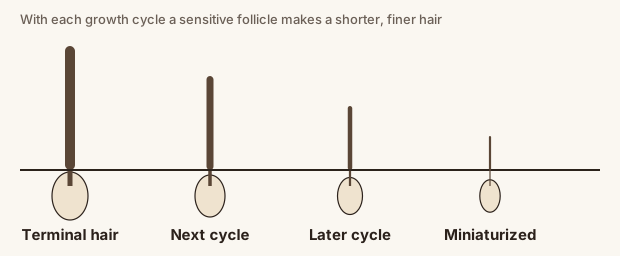
So two men with the same testosterone level can have very different hair. What differs is how their follicles respond.
The gene part
MedlinePlus Genetics says researchers suspect several genes play a role, but studies have confirmed only one so far: the AR gene. 2 It carries the instructions for the androgen receptor, the protein that lets cells respond to DHT and other androgens. 2
Studies suggest variations in the AR gene make androgen receptors easier to stimulate, increasing their activity in hair follicles. 2 How exactly that leads to hair loss is still unclear. 2
DermNet says several genes are involved, and that this explains the different ages of onset, progression, pattern and severity seen in family members. 1 It also says the susceptibility genes come from both mother and father. 1
The mother's-side question
The AR gene is on the X chromosome, and men inherit their X chromosome from their mother. 3 That is where the "it comes from your mother's father" idea started. Cleveland Clinic says that if your maternal grandfather has male pattern baldness, there is a good chance you will too. 3
The father's side counts as well. Cleveland Clinic says that if your father is bald, you are twice as likely to have male pattern baldness. 3 MedlinePlus Genetics says the inheritance pattern is unclear, and that having a close relative with patterned hair loss appears to be a risk factor. 2
A genetic test won't settle it. DermNet says genetic testing to predict balding is unreliable at this time. 1
Common myths about hormones and hair
- "Bald men have more testosterone." The mechanism is follicle sensitivity, not hormone level. 1 2 None of the medical sources here describe balding as a sign of higher testosterone.
- "Women don't have androgens." They do. MedlinePlus Genetics notes androgens regulate hair growth in both sexes. 2 But in women's pattern hair loss, other unknown factors are also involved, and DermNet notes most women with it have normal androgen levels. 2 5
- "Stress hormones cause pattern baldness." Stress is linked to a different kind of hair loss: sudden shedding a few months after a shock, which is usually temporary. 6
Is pattern hair loss linked to other health problems?
MedlinePlus Genetics notes that androgenetic alopecia in men has been associated with several other conditions, including coronary heart disease and enlargement of the prostate. 2 Prostate cancer, insulin resistance and high blood pressure have also been related to it. 2 Researchers are still investigating these links, and some may reflect higher androgen levels. 2
An association is not a diagnosis. Hair loss alone does not mean any of these conditions is present. It is a reasonable thing to mention at a routine checkup, alongside family history and blood pressure.
In women, pattern hair loss with acne, irregular periods and extra facial or body hair can point to excess androgens, such as in polycystic ovary syndrome. 5 2 That combination is worth raising with a doctor.
What this means in practice
You can't change your genes. You also can't safely change your testosterone to protect your hair, and nothing in these sources suggests trying. What medicine can do is act on the DHT pathway or on the follicle directly, and only while it is used. 7
The American Academy of Dermatology says treatment is optional, and that men who start soon after noticing loss tend to see the best results. 7 If you want to know where you are, the Norwood scale describes the stages. If something doesn't fit the usual pattern, have it checked.

- DermNet, “Male pattern hair loss (androgenetic alopecia, balding)”. dermnetnz.org/topics/male-pattern-hair-loss
- MedlinePlus Genetics (NIH), “Androgenetic alopecia: MedlinePlus Genetics”. medlineplus.gov/genetics/condition/androgenetic-alopecia/
- Cleveland Clinic, “Male Pattern Baldness (Androgenic Alopecia): Stages, Treatment”. my.clevelandclinic.org/health/diseases/24515-male-pattern-baldness-andro
- DermNet, “Finasteride”. dermnetnz.org/topics/finasteride
- DermNet, “Female pattern hair loss”. dermnetnz.org/topics/female-pattern-hair-loss
- American Academy of Dermatology, “Do you have hair loss or hair shedding?”. aad.org/public/diseases/hair-loss/insider/shedding
- American Academy of Dermatology, “What is male pattern hair loss, and can it be treated?”. aad.org/public/diseases/hair-loss/treatment/male-pattern-hair-loss-treat
- American Academy of Dermatology, “Hair loss: Signs and symptoms”. aad.org/public/diseases/hair-loss/insider/begin
- Mayo Clinic, “Hair loss - Symptoms and causes”. mayoclinic.org/diseases-conditions/hair-loss/symptoms-causes/syc-2037292
General information, not medical advice. This article was drafted with AI assistance and checked against the sources listed above. Nobody at Balds is a doctor. If something here is wrong or out of date, tell us.