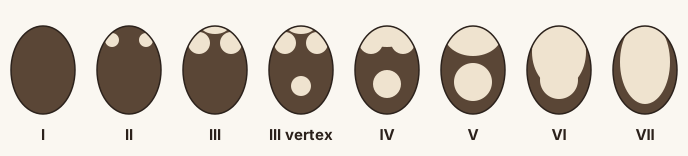
The Hamilton–Norwood scale sorts male pattern hair loss into seven stages, from little or no recession (stage 1) to a thin band of hair around the sides and back (stage 7). 1 It describes how far the pattern has gone. It does not predict how fast, or how far, any one man's hair will go, because age of onset, speed and severity vary even within families. 2
Male pattern hair loss is the most common type of hair loss in men. 3 It also follows a shape that is easy to recognize. The hairline moves back at the temples, the crown thins, and over years the two areas can meet. Doctors describe that progression with a scale, usually called the Norwood scale or the Hamilton–Norwood scale. 1
This guide walks through each stage, explains why the pattern happens, and covers what the scale is and is not good for.
What male pattern hair loss is
The medical name is androgenetic alopecia. 3 4 DermNet describes it as a combination of hormones called androgens and a genetic predisposition. 2 Men with it inherit a sensitivity to dihydrotestosterone, or DHT, in some areas of the scalp. 2
In those areas, DHT is believed to shorten the growing phase of the hair cycle. DermNet says it drops from a usual 3–6 years to just weeks or months. 2 Each new hair grows for less time, so it ends up shorter and finer. The follicles also shrink. Doctors call this miniaturization. Over many cycles the follicle makes fewer and finer hairs. 2
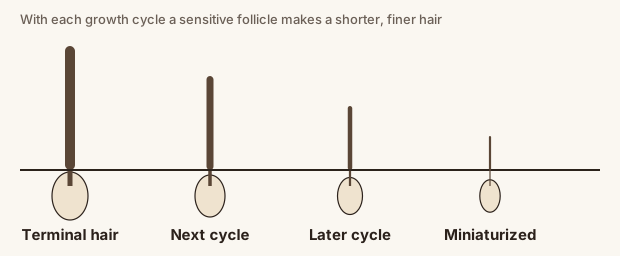
DermNet adds a detail that explains why thinning looks gradual. Scalp hairs grow in small tufts of 3–4. In pattern hair loss the tufts lose hairs one by one. Bald scalp shows only when a whole tuft is gone. 2
The seven stages, one by one
Cleveland Clinic describes the stages of the Hamilton–Norwood scale like this. 1 The drawing below shows them seen from above, with the front of the head at the top.
| Stage | What it looks like |
|---|---|
| Stage 1 | Little or no hair loss or hairline recession. 1 |
| Stage 2 | Slight hair loss at the temples, the skin between the ears and the forehead. 1 |
| Stage 3 | Deep recession around the temples. The hairline may take an "M" or "U" shape. 1 |
| Stage 4 | Very deep recession at the front, plus hair loss at the crown. 1 |
| Stage 5 | The receding front connects to the bald spot on the crown. 1 |
| Stage 6 | The hair between the temples and the crown is thinning or gone. 1 |
| Stage 7 | No hair on top of the head, and a thin band of hair around the sides. 1 |
Not everyone starts at the front. MedlinePlus Genetics describes the classic path as beginning above both temples, with the hairline receding into an "M" shape and thinning at the crown. 4 Some men notice the crown first. Mayo Clinic notes that hair loss can appear in different ways depending on the cause. 5 Our guide to a thinning crown covers loss that starts at the back.

How it usually progresses over time
Male pattern hair loss tends to develop slowly. The American Academy of Dermatology says it can cause thinning and loss for years, beginning as a receding hairline or a bald spot on top of the head. 3
When it starts varies a lot. The AAD says it sometimes begins in the late teens or early twenties, though usually it appears later. 3 Cleveland Clinic says about 25% of men see the first signs before age 21. 1 Many more notice it in their thirties. 1
The pace is not steady either. DermNet notes that several genes are involved. That is why age of onset, speed, pattern and severity can differ between members of the same family. 2 Two brothers can be at very different stages at the same age.
The last stage is not a destination for everyone. Several genes shape the speed and severity of the loss, so the scale cannot say where any one man will stop. 2 It describes where a pattern is now. It is not a timetable for where it is going. Comparing photos taken a year apart tells you more about your own pace than any single snapshot does.
How common it is
Very common, and more so with age. The figures differ a little between sources, but they agree on the direction.
- The American Academy of Dermatology says that by age 50, more than half of white men have a visible sign such as thinning, a receding hairline or balding. 3
- MedlinePlus Genetics says more than 50 percent of men over age 50 have some degree of hair loss, and estimates that androgenetic alopecia affects 50 million men in the United States. 4
- DermNet says up to half of Caucasian men have some hair loss by age 50, and possibly as many as 80% by 70. 2
- Cleveland Clinic says about 70% of men will lose hair as they get older. 1
Rates vary between populations. DermNet and Cleveland Clinic both note that Chinese and Japanese men are less affected than white men. 2 1 A family history raises the odds. 1
Does it come from your mother's side?
This is one of the most repeated ideas about baldness, and it is only partly true. The androgen receptor gene, which helps decide how sensitive follicles are, sits on the X chromosome. 1 4 Men get their X chromosome from their mother. So the mother's side does matter.
But it is not the whole story. DermNet says several genes are involved and the susceptibility is inherited from both parents. 2 Cleveland Clinic says that if your father is bald, you are twice as likely to have male pattern baldness. 1 MedlinePlus Genetics calls the inheritance pattern unclear because many genetic and environmental factors are likely involved. 4
What about a genetic test? DermNet says genetic testing to predict balding is unreliable at this time. 2 Looking at the men on both sides of your family is about as good a guide as there is, and it is still only a guide. Our guide to genes, testosterone and baldness goes deeper.
What the scale can't tell you
The Norwood scale is a shared vocabulary. It lets a man and his doctor describe a pattern the same way, and lets research compare like with like. It has limits worth knowing.
- It does not diagnose. Other conditions can thin the hair at the front or crown. A doctor checks the scalp, asks about history, and sometimes looks closer. Cleveland Clinic lists a scalp exam, a hair sample sent to a lab, or a scalp biopsy if the loss may be something else. 1
- It does not predict. Onset, speed and severity vary even within families. 2
- It does not fit everyone. It was drawn for the typical male pattern. Women's pattern loss looks different: the hairline usually stays and the part widens. 4 Women's loss is described with other scales, such as the Ludwig scale.
Signs it may not be pattern hair loss
Pattern hair loss is gradual and follows the shape above. It does not hurt. 1 These signs point elsewhere, and are worth a doctor's look sooner rather than later.
- Hair coming out suddenly, or in clumps when you comb. 6
- A round bald patch appearing within 1 or 2 days. 6
- Burning, itching, tenderness, scaling or sores on the scalp. 6
- Bald spots in the beard or eyebrows. 7
What men do about it
Treating male pattern hair loss is a choice, not a requirement. The American Academy of Dermatology says you don't need to treat it, but treatment options exist. 3 Mayo Clinic notes that some people let hair loss run its course untreated and unhidden. 5 Others cover it, and others choose treatment.
The AAD names two medicines approved by the FDA for male pattern hair loss: topical minoxidil, available without a prescription, and finasteride, a prescription pill. 3 It says men who start soon after noticing loss tend to see the best results. 3 Both work only as long as they are used. 3 Procedures include hair transplants. 3
Balds doesn't rank these, because the right choice depends on the person, their health and what they want. Our guides to what each option involves, minoxidil and finasteride set out the questions to take to a doctor. Our guide to shaving your head covers the other path.
- Cleveland Clinic, “Male Pattern Baldness (Androgenic Alopecia): Stages, Treatment”. my.clevelandclinic.org/health/diseases/24515-male-pattern-baldness-andro
- DermNet, “Male pattern hair loss (androgenetic alopecia, balding)”. dermnetnz.org/topics/male-pattern-hair-loss
- American Academy of Dermatology, “What is male pattern hair loss, and can it be treated?”. aad.org/public/diseases/hair-loss/treatment/male-pattern-hair-loss-treat
- MedlinePlus Genetics (NIH), “Androgenetic alopecia: MedlinePlus Genetics”. medlineplus.gov/genetics/condition/androgenetic-alopecia/
- Mayo Clinic, “Hair loss - Symptoms and causes”. mayoclinic.org/diseases-conditions/hair-loss/symptoms-causes/syc-2037292
- American Academy of Dermatology, “Hair loss: Signs and symptoms”. aad.org/public/diseases/hair-loss/insider/begin
- MedlinePlus (NIH), “Hair loss: MedlinePlus Medical Encyclopedia”. medlineplus.gov/ency/article/003246.htm
General information, not medical advice. This article was drafted with AI assistance and checked against the sources listed above. Nobody at Balds is a doctor. If something here is wrong or out of date, tell us.