In men, thinning at the temples is usually the start of male pattern hair loss, which begins above both temples and forms an "M" shape over time. 1 Tight hairstyles can also thin the temples, since the hairline is one of the first places traction shows. 2 In women, a band of hair loss along the front and sides, often with thinning eyebrows, can be frontal fibrosing alopecia, which needs early treatment. 3
The temples are the patches of hair on either side of the forehead, above the outer corners of the eyes. Hair there often thins before anywhere else. Because the area frames the face, small changes are easy to notice in a mirror or a photo.
Temple thinning has three main explanations. Which one fits depends on your sex, your hairstyles, and what else is happening on the scalp.
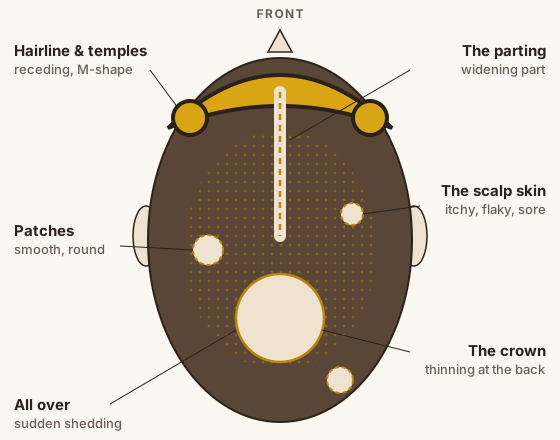
In men: usually the start of pattern hair loss
MedlinePlus Genetics describes male pattern hair loss as beginning above both temples. Over time the hairline recedes to form a characteristic "M" shape. 1 Cleveland Clinic describes the same early stages. At stage 2 there is slight loss at the temples. At stage 3 the recession is deep, and the hairline may form an "M" or "U". 4
The temples go first because those follicles carry an inherited sensitivity to the hormone DHT. 5 Under its influence the hairs grow for a shorter time and come back finer. 5 That is why early temple loss often looks like wispy, see-through hair before it looks like bare skin.
It is very common. The American Academy of Dermatology says male pattern hair loss can start in the late teens or early twenties, though usually it appears later. 6 Our guide to the Norwood scale shows how the temples fit into the full pattern.

In anyone: pulling from tight styles
The second cause is mechanical. The American Academy of Dermatology says your hairline is one of the first places traction alopecia shows. 2 It comes from styles that pull, such as tight ponytails, buns, braids, cornrows, weaves and extensions. 2
The AAD names girls and women of African descent, ballet dancers, military personnel and anyone required to pull their hair back for work as being at higher risk. 2 A style that hurts is too tight. 2
This kind of temple loss can recover if the pulling stops early. If it continues, the AAD says the skin can become shiny and bald, and at that stage the hair cannot grow back. 2 Our guide to traction alopecia covers the early signs and safer styling.
In women: a receding hairline worth checking soon
Women's pattern hair loss rarely starts at the temples. MedlinePlus Genetics says that in women the part widens and the hairline does not usually recede. 1 So a receding hairline in a woman calls for a closer look.
One cause is frontal fibrosing alopecia, or FFA. The American Academy of Dermatology says it often looks like a receding hairline along the front and sides of the head. It tends to start slowly, as a thin band of balding skin. 3 Mayo Clinic notes that a receding hairline is an increasingly common pattern in older women, and points to FFA. 7
Some features help tell FFA apart:
- Eyebrows. The AAD says the first sign is often noticeable loss of eyebrow hair. Between 80% and 95% of women diagnosed with FFA have lost some or all of their eyebrows. 3
- Timing. FFA is usually diagnosed after menopause, often about two to 12 years after it begins. 3 It can start earlier, and the AAD notes this may be most common in Black women. 3
- It scars. FFA destroys hair follicles and causes permanent hair loss. 3
Because FFA scars, timing matters. The AAD says that with early diagnosis and treatment from a dermatologist, it is possible to stop it progressing. 3 Mayo Clinic advises women with a receding hairline to ask their doctor about early treatment to avoid significant permanent baldness. 7 Men can get FFA too, though most people diagnosed are women. 3

Telling the three apart
| Pattern hair loss | Traction | Frontal fibrosing alopecia | |
|---|---|---|---|
| Who | Mostly men at the temples 1 | Anyone who wears tight styles 2 | Mostly women after menopause 3 |
| How it starts | Recession above both temples toward an "M" 1 | Thinning where hair is pulled hardest, often the edges 2 | A thin band along the front and sides, often with eyebrow loss 3 |
| Speed | Slow, over years 6 | Builds with repeated pulling 2 | Usually slow, sometimes fast 3 |
| Can it recover? | Treatment can slow it; it continues without treatment 6 | Often, if caught before scarring 2 | Lost hair rarely returns; early treatment can stop further loss 3 |
When to see a dermatologist
Gradual temple recession in a man with a family history is usually pattern hair loss. It needs a doctor only if you want treatment or want to be sure. Other combinations deserve a prompt appointment:
- a receding hairline in a woman, especially with thinning eyebrows; 3 7
- soreness, small bumps or broken hairs where styles pull; 2
- redness, itching or scaling along the hairline; 8
- temple loss with patches elsewhere on the scalp. 7
Our guide to what happens at a hair loss appointment explains what to bring and what a dermatologist checks.
- MedlinePlus Genetics (NIH), “Androgenetic alopecia: MedlinePlus Genetics”. medlineplus.gov/genetics/condition/androgenetic-alopecia/
- American Academy of Dermatology, “Hairstyles that pull can lead to hair loss”. aad.org/public/diseases/hair-loss/causes/hairstyles
- American Academy of Dermatology, “Hair loss types: Frontal fibrosing alopecia overview”. aad.org/public/diseases/hair-loss/types/frontal-fibrosing-alopecia
- Cleveland Clinic, “Male Pattern Baldness (Androgenic Alopecia): Stages, Treatment”. my.clevelandclinic.org/health/diseases/24515-male-pattern-baldness-andro
- DermNet, “Male pattern hair loss (androgenetic alopecia, balding)”. dermnetnz.org/topics/male-pattern-hair-loss
- American Academy of Dermatology, “What is male pattern hair loss, and can it be treated?”. aad.org/public/diseases/hair-loss/treatment/male-pattern-hair-loss-treat
- Mayo Clinic, “Hair loss - Symptoms and causes”. mayoclinic.org/diseases-conditions/hair-loss/symptoms-causes/syc-2037292
- American Academy of Dermatology, “Hair loss: Signs and symptoms”. aad.org/public/diseases/hair-loss/insider/begin
General information, not medical advice. This article was drafted with AI assistance and checked against the sources listed above. Nobody at Balds is a doctor. If something here is wrong or out of date, tell us.