The Ludwig scale grades female pattern hair loss in three steps: grade I is perceptible thinning on the crown, starting 1–3 cm behind the front hairline; grade II is pronounced thinning in the same area; grade III is full baldness within it. 1 Throughout, the front hairline is kept. 2 Grade III is uncommon, affecting less than 1% of women. 1
When doctors talk about how far female pattern hair loss has gone, they need a shared language. The oldest and best-known is the Ludwig scale. A review of hair loss classifications calls it, with the Norwood–Hamilton scale, one of the most widely used by patients and practitioners. 2
This guide explains the three grades, shows them as a drawing, and covers the newer scales that fill its gaps.
Where it comes from
The review says Ludwig studied 468 women with hair loss and proposed a classification based on how the loss evolves. 2 His key observation was that women keep the front fringe of hair while loss spreads out over the top of the scalp. 2 That is the main way women's pattern differs from men's. MedlinePlus Genetics describes the same difference: in women the part widens and the hairline does not typically recede. 3
The three grades
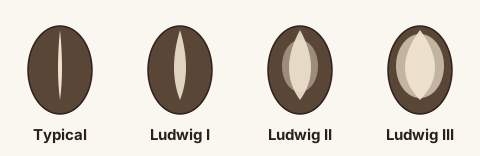
| Grade | Ludwig's description | In plain words |
|---|---|---|
| I | Perceptible thinning of the hair on the crown, limited in front by a line 1–3 cm behind the frontal hairline. 1 | You can see some scalp on top. The front edge of the hair looks normal. |
| II | Pronounced rarefaction of the hair on the crown, within the area seen in grade I. 1 | Clearly thinner on top, in the same zone. |
| III | Full baldness within the area seen in grades I and II. 1 | The top is bare, still with a fringe of hair at the front. |
Most women never reach grade III. The review says severe loss of that degree affects less than 1% of women. 1

What the Ludwig scale leaves out
The scale is simple, which is both its strength and its weakness. The review points out two gaps. 2
- The "Christmas tree" shape. Many women lose density toward the front along the part, in a triangle. Ludwig did not include that accentuation. Olsen later did. 2
- Male-pattern loss in women. Some women develop recession at the temples, like men. Ludwig's system cannot classify them. 2 Later scales by Ebling and Rook allowed for it. 2
It also has only three steps, so it is coarse for tracking change. A woman can lose noticeable density and still be "grade I".
The scales doctors use alongside it
| Scale | How it works |
|---|---|
| Ludwig | Three grades of thinning over the crown with the front hairline kept. 1 |
| Savin | A set of drawings showing eight stages of increasing thinning on top, plus a category for frontal recession. 2 |
| Olsen | Similar to Ludwig but adds the triangular "Christmas tree" pattern seen along a middle part. 2 |
| Sinclair | Five grades judged on the middle part, from normal to advanced loss. Simple enough for patients to use themselves. 1 2 |
The Sinclair scale is the easiest to use at home, because it only needs a comb and a photo from above. Our guide to the widening part explains how.
How a grade is actually used
A grade is mostly a tracking tool. The review says these scales help determine the stage of hair loss and assess the response to treatment. 2 DermNet says doctors can score shedding at each visit to judge how treatment is going. 4
A grade doesn't diagnose anything by itself. The American Academy of Dermatology notes that other conditions can look like female pattern hair loss, so a dermatologist should rule them out first. 5 A grade also doesn't predict the future. DermNet says the loss usually comes in bursts and pauses, and the pace differs between women. 4
If you grade yourself
Grading your own hair is fine, as long as you treat it as a note rather than a verdict. Use the same light, the same part and the same camera height each time. Look at the top of the head from directly above, not in a wall mirror. Compare photos months apart, because the loss tends to come in bursts. 4 If two photos a few months apart look the same, that is useful information too. It suggests a pause, not a failure. Write the date on each photo, and note anything that happened in between, such as an illness, a new medicine or a birth. Those events can cause shedding of their own a few months later. 6
How it compares with the Norwood scale
The Norwood scale for men has seven main stages and tracks recession at the temples and loss at the crown. 7 The Ludwig scale has three, and tracks density on top with the hairline kept. 1 They describe genuinely different patterns, which is why a woman's hair loss is not usually graded on the men's scale. Our guide to the Norwood scale covers the men's version.
What to do with your grade
If you recognize grade I or II in your own photos, it is worth a dermatologist's opinion. The AAD says treatment for female pattern hair loss works best when started at the first sign. 5 If your loss has a patchy shape, a sudden start or a sore scalp, it may be something else, and that is a reason to go sooner.

- Dinh & Sinclair, Clin Interv Aging (PMC), “Female pattern hair loss: Current treatment concepts - PMC”. pmc.ncbi.nlm.nih.gov/articles/PMC2684510/
- Gupta & Mysore, J Cutan Aesthet Surg (PMC), “Classifications of Patterned Hair Loss: A Review - PMC”. pmc.ncbi.nlm.nih.gov/articles/PMC4812885/
- MedlinePlus Genetics (NIH), “Androgenetic alopecia: MedlinePlus Genetics”. medlineplus.gov/genetics/condition/androgenetic-alopecia/
- DermNet, “Female pattern hair loss”. dermnetnz.org/topics/female-pattern-hair-loss
- American Academy of Dermatology, “Thinning hair and hair loss: Could it be female pattern hair loss?”. aad.org/public/diseases/hair-loss/types/female-pattern
- American Academy of Dermatology, “Do you have hair loss or hair shedding?”. aad.org/public/diseases/hair-loss/insider/shedding
- Cleveland Clinic, “Male Pattern Baldness (Androgenic Alopecia): Stages, Treatment”. my.clevelandclinic.org/health/diseases/24515-male-pattern-baldness-andro
- American Academy of Dermatology, “Hair loss: Signs and symptoms”. aad.org/public/diseases/hair-loss/insider/begin
- Mayo Clinic, “Hair loss - Symptoms and causes”. mayoclinic.org/diseases-conditions/hair-loss/symptoms-causes/syc-2037292
General information, not medical advice. This article was drafted with AI assistance and checked against the sources listed above. Nobody at Balds is a doctor. If something here is wrong or out of date, tell us.