In a pull test, a doctor gently pulls a cluster of hairs to see how many come out, which helps determine the stage of the shedding process. 1 2 Trichoscopy is a non-invasive way to look at the scalp and hair under magnification. 3 A blood test or scalp biopsy may be needed if a dermatologist suspects a disease, vitamin deficiency, hormone imbalance or infection. 4
A hair pull test is one of the simplest checks in a hair loss appointment. A doctor gently pulls on a group of hairs to see how many come out. 1 2 The Mayo Clinic says this helps determine the stage of the shedding process. 1
The pull test is usually just one part of the visit. Doctors may also magnify the scalp, look at hairs under a microscope, or take a small sample from a thin area. 3 2 This guide explains what each check involves and what it can show.
It starts with questions and a close look
Before any test, a doctor gathers information. The American Academy of Dermatology (AAD) says a dermatologist will ask how long you've had hair loss. They will also ask whether it came on quickly. 4 The Mayo Clinic adds questions about your diet, hair care routine, and medical and family history. 1 DermNet says a drug history should concentrate on the three months before the hair loss was noticed. 2 That includes new medicines, dose changes and over-the-counter supplements. 2
Then comes the exam. The AAD says a dermatologist will look closely at your scalp, your nails and any other area with hair loss. 4 DermNet says the scalp exam should assess the amount and pattern of loss. It also checks for redness or scaling and looks at the length, width and breakage of the hairs. 2 According to DermNet, a careful history and full skin examination can generally lead to the correct diagnosis. 5 Our guide to seeing a dermatologist about hair loss covers what to bring.

The hair pull test
The pull test is quick. The Cleveland Clinic describes a provider gently pulling a small clump of 40 to 60 hairs between their fingers. 6 The Mayo Clinic describes gently pulling several dozen hairs. 1 DermNet describes gentle pulling of a cluster of hairs from the base to the tip. 2
Two things matter: how many hairs come away, and what they look like. The AAD says gently pulling on your hair tells a dermatologist a lot. It shows how your hair is growing and whether it's prone to breaking. 4 DermNet lists the pull test as a way to determine the relative proportion of anagen and telogen hairs. 5 Anagen is the active growing phase. Telogen is the resting phase. 5 DermNet says up to 10% of hairs in a normal scalp are in telogen. 5
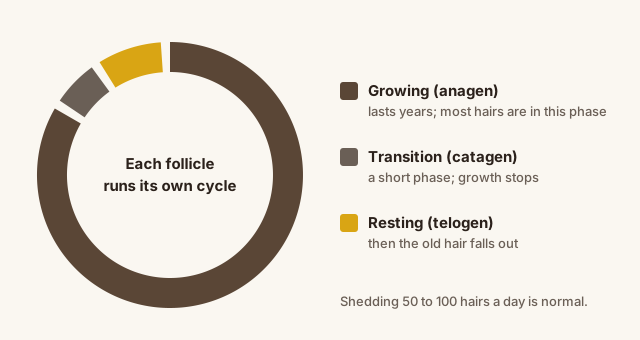
Sources give slightly different figures for a typical result. The Cleveland Clinic says that under typical conditions, a provider may only pull two to three hairs. 6 DermNet says that normally only 1-2 hairs come out. 2 With shedding, the count can be higher. 6 2 The Cleveland Clinic says that with telogen effluvium, a provider may pull at least four to six hairs with white bulbs at the roots. 6 DermNet says that in hair shedding conditions, 10-15 hairs may pull out. 2
If you have been counting hairs at home, our guide to how much hair loss a day is normal may help put the numbers in context.
Why the root of a hair matters
The root of a shed hair shows where it was in its cycle. DermNet says a telogen hair has a bulb at the end, called a club hair. 5 The Cleveland Clinic describes this as a white bulb of keratin at the root. 6 An anagen hair, by contrast, is tapered or broken off. 5
The hairs that come out in a pull test can go under a microscope. DermNet says they can be examined for anagen or telogen bulbs, fractures and tapering. 2 The Mayo Clinic describes a related check called light microscopy. Here a doctor uses a special instrument to examine hairs trimmed at their bases. 1 This helps uncover possible disorders of the hair shaft. 1 DermNet says hair shaft problems are diagnosed by dermatoscopy or by looking at the hair under a microscope. Sometimes a scanning electron microscope is used. 5
Hair and skin can also be checked for infection. DermNet lists skin scrapings and hair clippings for mycology among the possible tests. 5 The Mayo Clinic says examining samples from the skin or a few plucked hairs can help determine whether an infection is causing hair loss. 1 Our guide to scalp ringworm covers one fungal cause.

Trichoscopy: a magnified look at the scalp
Trichoscopy means examining the scalp and hair with a handheld or video magnifying device. 3 DermNet calls it a valuable, non-invasive and low-cost technique. 3 It lets a clinician see the hair and scalp at x20 to x160 magnifications. 3 Images can be recorded digitally and stored to compare over time. 3
DermNet says trichoscopy can help tell scarring from non-scarring hair loss. It can also help tell early androgenetic alopecia from telogen effluvium. 3 It can help predict the outlook in alopecia areata. 3 Other uses include monitoring treatment response and choosing the best spot for a scalp biopsy. 3 DermNet adds that it can reassure patients that their scalp has been thoroughly examined. 3
Some of the signs it shows have memorable names. DermNet describes these examples:
- Exclamation mark hairs: short hairs, paler at the base and thicker and darker at the tip. They are one of the most characteristic features of alopecia areata. 3
- Corkscrew hairs: the hallmark of tinea capitis. 3
- Flame hairs: remnants of recently pulled hairs, commonly seen in trichotillomania. 3
- Uneven hair thickness: seen in androgenetic alopecia because of miniaturization. 3
- Follicle openings: small, even openings usually point to non-scarring loss, while large, irregular ones usually point to scarring. 3
DermNet also notes that a brown honeycomb pattern is a normal finding in people with dark skin. 3 It says washing may remove important signs, so clinicians are advised to ask patients not to wash for at least 2–3 days before the exam. 3 Leftover hair dye, makeup foundation and cosmetic hair fibers on the scalp may also get in the way. 3 If your clinic gives its own instructions, follow those.
Scalp biopsy and blood tests
The AAD says you may need a blood test or scalp biopsy in some cases. This applies if a dermatologist suspects a disease, vitamin deficiency, hormone imbalance or infection. 4 It says these tests can be done in the dermatologist's office. 4 DermNet says a skin biopsy from an area where the hair is thin may be required to rule out other causes of diffuse hair loss. 2
Telling scarring from non-scarring loss is one reason a closer look can matter. DermNet says scarring alopecia is permanent. 5 Our guide to why early assessment matters in scarring hair loss explains more.
The Mayo Clinic says a blood test might help uncover medical conditions that can cause hair loss. 1 DermNet says that if the cause is unclear, it is usual to check at least a blood count, iron levels and thyroid function. 2
| Check | What happens | What it can show |
|---|---|---|
| Pull test | Several dozen hairs are gently pulled to see how many come out. 1 | The stage of the shedding process. 1 |
| Trichoscopy | A handheld or video device magnifies the scalp and hair. 3 | Can help tell scarring from non-scarring loss. 3 |
| Hair microscopy | Pulled or trimmed hairs are examined under a microscope. 2 1 | Growing or resting bulbs, fractures and tapering, or hair shaft disorders. 2 1 |
| Scalp biopsy | A sample from an area where hair is thin. 2 | May be required to rule out other causes of diffuse loss. 2 |
| Blood tests | A blood sample. 1 | Might help uncover medical conditions that can cause hair loss. 1 |
Not every visit needs tests
The Cleveland Clinic says that in most cases, a provider can diagnose telogen effluvium without any testing. 6 The AAD says that once a dermatologist has gathered information, it's often possible to tell you the cause. 4 Sometimes more information is needed, such as when someone has more than one cause. 4 The AAD's example is a woman shedding after having a baby. She may also have early hereditary loss that isn't so obvious. 4 Our guide to sudden shedding covers telogen effluvium in more depth.
When to get it checked
The Cleveland Clinic suggests reaching out to a healthcare provider as soon as you notice hair loss, especially if it causes added stress. 6 It says that with telogen effluvium, the scalp should look healthy. There should be no rash, itching, burning, pain or flaking. 6 DermNet says itch and soreness are generally absent unless an inflammatory skin disease is also present. 5 Hair loss can be temporary or permanent, depending on the cause. 5
The Mayo Clinic suggests bringing a list of questions. Some of its basic ones are: 1
- What is causing my hair loss? 1
- What kinds of tests do I need? 1
- Is my hair loss permanent, or will it grow back? 1
- Should I change my diet or hair care routine? 1
Whatever the result
Knowing the cause is useful, even if you decide to do nothing about it. DermNet notes that hair loss of any type may be extremely distressing. 5 It also says hair loss can be disguised or covered. 5 The Mayo Clinic lists approaches from volumizing products and wigs to shaving your head. 1 Living with less hair, and being at ease with it, is a fine outcome too.
- Mayo Clinic, “Hair loss - Diagnosis and treatment”. mayoclinic.org/diseases-conditions/hair-loss/diagnosis-treatment/drc-203
- DermNet, “Alopecia from drugs”. dermnetnz.org/topics/alopecia-from-drugs
- DermNet, “Trichoscopy: A Complete Overview — DermNet”. dermnetnz.org/topics/trichoscopy
- American Academy of Dermatology, “Hair loss: Diagnosis and treatment”. aad.org/public/diseases/hair-loss/treatment/diagnosis-treat
- DermNet, “Hair loss, balding, hair shedding, alopecia”. dermnetnz.org/topics/hair-loss
- Cleveland Clinic, “Telogen Effluvium: Symptoms, Causes, Treatment & Regrowth”. my.clevelandclinic.org/health/diseases/24486-telogen-effluvium
- American Academy of Dermatology, “Hair loss: Signs and symptoms”. aad.org/public/diseases/hair-loss/insider/begin
- Mayo Clinic, “Hair loss - Symptoms and causes”. mayoclinic.org/diseases-conditions/hair-loss/symptoms-causes/syc-2037292
General information, not medical advice. This article was drafted with AI assistance and checked against the sources listed above. Nobody at Balds is a doctor. If something here is wrong or out of date, tell us.