Scalp ringworm, or tinea capitis, is a contagious fungal infection of the scalp skin and hair that most often affects children. 1 2 It is treated with medicine taken by mouth, because topical agents cannot reach the root of the hair follicle. 1 2 Left untreated, it can lead to hair loss. 3
Scalp ringworm is a fungal infection of the scalp that involves both the skin and the hair. 2 Its medical name is tinea capitis. 1 Despite the name, it is not caused by worms. 4 It most often affects children, but it can occur at any age. 1
It is contagious, and it spreads through people, shared objects and animals. 2 Treatment is medicine taken by mouth, because topical agents cannot reach the root of the hair follicle. 1 2 Medicated shampoo has a supporting role: reducing the spread of spores. 2

What causes it
Scalp ringworm is caused by mold-like fungi called dermatophytes. 1 These fungi can live on the dead tissue of the hair, nails and outer skin layers. 1 They grow well in warm, moist areas. 1 After entering the outer layer of the scalp, the fungus grows down into the hair follicle and the hair shaft. 2 Infected hairs can break off, leaving small black dots. 1 2
Related ringworm infections include athlete's foot and jock itch. 1 In the United States, the most common cause is a fungus called Trichophyton tonsurans, which passes between people. 2 In New Zealand, Europe and Asia, the most common cause is a fungus that originates in cats. 2
Who gets it
DermNet says scalp ringworm mainly affects children before adolescence. 2 Cases peak between the ages of three and seven years. 2 It can also affect adults, particularly those with a weakened immune system. 2 MedlinePlus says that in many cases it gets better on its own after puberty. 1
DermNet lists risk factors including animal contact, household crowding, lower socioeconomic status, warm humid environments and contact sport. 2 MedlinePlus adds that infection is more likely with minor scalp injuries or infrequent hair washing. 1 Skin that stays wet for a long time, such as from sweating, also raises the chance. 1 Ringworm in general is a common infection. 4
What it looks like
Symptoms can include hair loss, dry scaly areas, redness and itch. 2 DermNet says partial hair loss with some degree of inflammation is characteristic of all types. 2 On the scalp, the rash may not look like the usual ring. 4 It may look red or darker than the surrounding skin, depending on skin tone. 4 Its color may be less noticeable on brown and black skin. 4
| Pattern | What it can look like |
|---|---|
| Gray patch | Fine scaling and patches of hair loss that look gray, because spores coat the hairs. 2 |
| Black dot | Fine scaling and bald patches speckled with black dots, which are broken hairs. 2 1 |
| Diffuse scale | Looks like general dandruff. Hair loss is subtle or absent. 2 |
| Kerion | A painful, red, boggy swelling with hair loss and scattered pus spots. It may result in permanent hair loss. 2 |
| Favus | Rare. Matted hair with yellow, crusted, cup-shaped patches around the base of the hairs. 2 |
MedlinePlus says you may also have a low-grade fever of around 100°F to 101°F, or swollen lymph nodes in the neck. 1 The infection may extend to the eyebrows and eyelashes. 2 The American Academy of Dermatology says scaly bald patches, often with sores or blisters that open and ooze pus, often mean a fungal infection on the scalp. 5
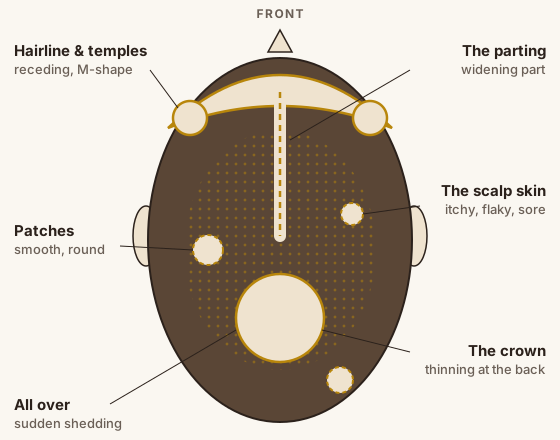
How it spreads at home and school
Ringworm can spread quickly. 1 You can catch it through direct contact with ringworm on someone else's body. 1 DermNet notes this includes people who carry the fungus without symptoms. 2
Shared objects can carry it too. 1 DermNet lists hairbrushes, hats, towels, bedding, couches and toys. 2 It says fungal spores may stay viable on these for months. 2
Pets can spread it, particularly cats. 1 DermNet says animal fungi come from household pets, especially kittens, and from stray cats and dogs. 2 These fungi can then pass from person to person. 2 Catching ringworm from soil is less common. 4
For school, the NHS says it is fine for a child to go once they have started treatment. 4 It also suggests letting the child's teachers know. 4
How it is diagnosed
A health care provider will look at the scalp for signs of ringworm. 1 DermNet says it is usually suspected on sight but should be confirmed with microscopy and culture. 2 Scrapings or plucked hairs are checked under a microscope, which can confirm it quickly. 2 A fungal culture identifies the fungus, and so the possible source of infection. 2 Culture is slow, taking up to 4 weeks, so treatment usually starts before the result is back. 2
A Wood lamp examination can show infected hairs glowing, but few fungi cause this. 2 Scalp dermoscopy is fast and non-invasive. 2 It can help confirm the infection so treatment can start while culture results are pending. 2 Our guide to seeing a dermatologist about hair loss covers what an appointment involves.

Why creams are not enough
DermNet says tinea capitis always requires at least 4 weeks of medicine that works through the whole body. 2 The reason is that topical agents cannot penetrate the root of the hair follicle. 2 MedlinePlus says a provider will prescribe medicine taken by mouth, for 4 to 8 weeks. 1 The NHS says scalp ringworm usually needs prescription antifungal tablets and shampoo. 4
Medicated shampoo, such as one with ketoconazole or selenium sulfide, is part of home care. 1 MedlinePlus says shampooing may slow or stop the spread of infection, but it does not get rid of ringworm. 1 The NHS stresses using antifungal medicine for the right amount of time, even if the rash has gone away. 4
Two things are worth knowing ahead of time. With the inflammatory forms, a second rash may appear, particularly after treatment starts. 2 DermNet calls this an id reaction. 2 Ringworm may also be hard to get rid of, and it may come back after treatment. 1
Steps for the whole household
Scalp ringworm involves the whole home, not just one person. These are the steps the sources describe.
- Check everyone. DermNet says all household members should be screened and treated at the same time if affected. 2
- Check pets. When the fungus comes from animals, family pets should be checked by a veterinarian. 2 The NHS mentions patches of missing fur as a possible sign. 4
- Shampoo for others. MedlinePlus says other children in the home may want to use the shampoo. Adults only need it if they have signs. 1
- Wash towels hot. Use hot, soapy water and the hottest dryer heat the care label allows, each time the infected person uses them. 1
- Soak combs and brushes. MedlinePlus suggests 1 hour a day in 1 part bleach to 10 parts water, for 3 days in a row. 1
- Stop sharing. No one in the home should share combs, hairbrushes, hats, towels, pillowcases or helmets. 1
- Hands off. The NHS suggests washing hands after touching animals or soil. Scratching could spread the rash to other parts of the body. 4
Why early treatment matters for hair
The American Academy of Dermatology says that, left untreated, scalp ringworm can lead to hair loss. 3 MedlinePlus says it may cause permanent hair loss and lasting scars. 1 DermNet says severe inflammatory tinea capitis may result in areas of permanent hair loss. 2 By contrast, it says the non-inflammatory form carries an excellent outlook with appropriate and early treatment. 2
The AAD says the sooner you find the cause of hair loss, the better your outcome. 3 The NHS advises starting ringworm treatment as soon as possible. 4
DermNet notes that hair loss can cause real distress, especially when bald patches are permanent. 2 That feeling deserves to be taken seriously. So does the choice to simply live with a patch. Our guide to scarring hair loss explains more about permanent patches.
When to get help
The NHS lists ringworm on the scalp among the reasons to see a doctor. It usually needs prescription tablets and shampoo. 4 The NHS also lists a weakened immune system, for example from chemotherapy, steroids or diabetes. 4 MedlinePlus says to contact a provider if you have symptoms and home care is not enough. 1 A painful, swollen area with pus spots may be a kerion, which may result in permanent hair loss. 2 For other causes of a sore or flaky scalp, see itchy scalp and hair loss: when to get it checked.
Conditions it can be mistaken for
Many scalp conditions can cause patchy hair loss, inflammation or scaling. 2 DermNet points out some differences.
- Alopecia areata and trichotillomania cause patchy hair loss, but the patches are not scaly. 2
- Seborrheic dermatitis, atopic dermatitis and scalp psoriasis may mimic the non-inflammatory form. Their scale is usually more diffuse. 2
- Bacterial infections of the follicles and skin may resemble the inflammatory form. 2
The short version
Scalp ringworm is a contagious fungal infection that most often affects children. 1 2 It needs medicine taken by mouth, because topical agents cannot reach the root of the follicle. 2 Medicated shampoo may slow or stop the spread, but it does not get rid of ringworm. 1 Family members and pets should be examined too. 1 2 Left untreated, it can lead to hair loss. 3 A patchy, scaly scalp is worth having looked at early.

- MedlinePlus (NIH), “Ringworm of the scalp: MedlinePlus Medical Encyclopedia”. medlineplus.gov/ency/article/000878.htm
- DermNet, “Tinea capitis”. dermnetnz.org/topics/tinea-capitis
- American Academy of Dermatology, “Hair loss: Overview”. aad.org/public/diseases/hair-loss/causes/fall-out
- NHS, “Ringworm”. nhs.uk/conditions/ringworm/
- American Academy of Dermatology, “Hair loss: Signs and symptoms”. aad.org/public/diseases/hair-loss/insider/begin
- Mayo Clinic, “Hair loss - Symptoms and causes”. mayoclinic.org/diseases-conditions/hair-loss/symptoms-causes/syc-2037292
General information, not medical advice. This article was drafted with AI assistance and checked against the sources listed above. Nobody at Balds is a doctor. If something here is wrong or out of date, tell us.