Frontal fibrosing alopecia (FFA) is a type of hair loss that destroys hair follicles and often causes a thin band of balding skin at the hairline. 1 Many people also lose some or all of their eyebrows. 1 The American Academy of Dermatology says that with early diagnosis and medical treatment from a board-certified dermatologist, it's possible to stop the disease from progressing. 1
Frontal fibrosing alopecia, or FFA, is a type of hair loss that often looks like a receding hairline. 1 It destroys hair follicles, causing permanent hair loss. 1 That is why timing matters.
The American Academy of Dermatology (AAD) says early diagnosis and medical treatment from a board-certified dermatologist can make it possible to stop the disease from progressing and causing further permanent hair loss. 1 This guide covers what FFA looks like, who tends to get it, why it scars, and how it is diagnosed.

What FFA looks like
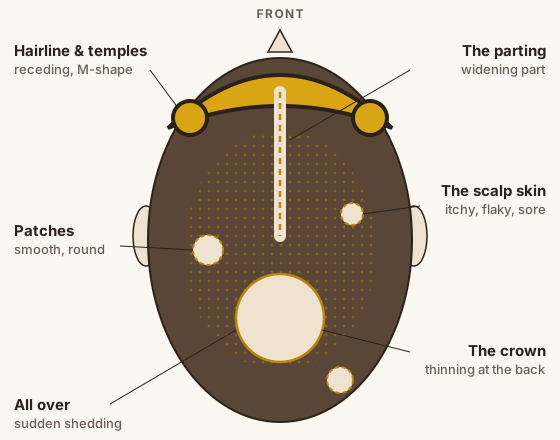
FFA tends to start slowly. 1 It often causes a thin band of balding skin along the front and sides of the hairline. 1 At first, the receding hairline can be barely noticeable. 1 Because FFA often develops slowly, the earliest signs can be hard to notice. 1
In scarring hair loss in general, the skin where hair used to be tends to look smooth and shiny. 2 Some people also have redness, flaky skin or blisters. 2
A receding hairline is not always FFA. In men, hair often begins to recede at the hairline on the forehead as part of the most common, gradual type of hair loss. 3 Mayo Clinic describes a receding hairline in older women, frontal fibrosing alopecia, as an increasingly common hair loss pattern. 3 If the change is mostly at the sides, our guide to hair loss at the temples walks through the usual possibilities.
Eyebrows and hair elsewhere
FFA is not limited to the scalp. Anywhere you have hair, you may notice hair loss. 1 The first sign you may see is often noticeable loss of eyebrow hairs. 1 Between 80% and 95% of women diagnosed with FFA have lost some or all of their eyebrows. 1
- Eyelashes. Some people lose their eyelashes. 4
- Body hair. As the hair loss advances, some people lose pubic hair, underarm hair, or hair on their arms or legs. 1
- Beard area. People with facial hair may notice less hair in their beard area. 1
Thinning brows are worth mentioning to a doctor, even if your hairline looks unchanged.
Who gets FFA, and when
People around the world develop FFA. 1 Most are women, but men have also been diagnosed with it. 1 The number of people being diagnosed is growing rapidly. 1 It is not contagious. 1
FFA is usually diagnosed in women after menopause, meaning no period for at least one year. 1 Most notice hair loss about two to 12 years after they start menopause. 1 Hormonal changes due to menopause can also cause hair loss on their own. 3 Our guide to menopause and hair thinning covers that side.
FFA can also be diagnosed earlier in life, and this may be most common in Black women. 1 In a small study of Black American women with FFA, their ages ranged from 28 to 85 years old. 1 About half were not in menopause when they were diagnosed. 1 The AAD notes that because the study was small, more research is needed. 1
Why FFA scars
FFA belongs to the group called scarring, or cicatricial, alopecia. 1 5 As FFA progresses, the hair follicles scar over. 1 Once a follicle scars, it can no longer grow hair. 1
Cleveland Clinic explains the general process. In most types of scarring hair loss, inflammation develops around the middle of the follicle, called the bulge. 2 This part holds stem cells and oil glands, which are both needed for new hair growth. 2 Inflammation destroys it and scar tissue grows, so hair can't regenerate. 2 In nonscarring hair loss, damage is usually at the base of the follicle instead. 2 That is why hair can often regrow in those types. 2
Cleveland Clinic says scarring alopecia accounts for about 7% of people who see healthcare providers about hair loss. 2 Our guide to scarring hair loss and early assessment covers the wider group.

How it progresses
FFA tends to develop slowly. 1 It can also come on rapidly, and some people develop patches of hair loss rather than a slowly receding hairline. 1 Without medical treatment, FFA often causes permanent hair loss that covers a larger area with each passing year. 1 The bald band can reach the middle of the head, or even further back. 1
For some people, FFA does stop after so many years. 1 But it is not possible to know who will experience this, which is why dermatologists recommend treatment. 1
How FFA is diagnosed
A dermatologist can diagnose scarring alopecia. 2 Cleveland Clinic says it can be difficult to diagnose, so it's important to see a dermatologist with a lot of experience in hair loss. 2 Our guide to seeing a dermatologist about hair loss covers what to bring.
- A look at the scalp and skin. The provider checks the location and pattern of hair loss, and whether follicle openings and signs of inflammation are visible. 2 Report when you first noticed the loss and any tingling, burning or itching. 2
- Your medical history. This covers age, sex, hair care practices and overall health, and blood tests may check for other causes. 2
- A magnified scalp exam. Trichoscopy uses a handheld or video device to examine the scalp and hair. 5 It can help tell scarring from nonscarring hair loss. 5
- A skin biopsy. A small skin sample, looked at under a microscope, can confirm a diagnosis of scarring alopecia. 2
On trichoscopy, DermNet describes localized scaling around the follicles in FFA. 5 Pink dots are occasionally seen in the eyebrow area. 5 Large, irregular follicle openings with an uneven spread usually point to scarring hair loss. 5 DermNet advises asking patients not to wash their hair for at least 2–3 days before the exam, because washing may remove important signs. 5
Sometimes a biopsy shows scar tissue but no inflammatory cells. 2 That means the condition is past active inflammation, and treatment might be less effective. 2
What early treatment aims to do
The American Academy of Dermatology says that, caught early, medical treatment can stop further hair loss. 1 It adds that the earlier someone is diagnosed and starts treatment, the more effective treatment tends to be. 1 If FFA is caught early and treated, the AAD says you may regrow some hair. 1
For scarring alopecia in general, Cleveland Clinic says there isn't a cure. 2 Treatment aims to manage symptoms and slow or stop more hair loss. 2 Anti-inflammatory medication is the most common treatment for most forms, and it fights the inflammatory cells that destroy follicles. 2 It can come as a pill, an injection, or a cream or oil applied to the skin. 2 Which one fits is a decision to make with a dermatologist.
In scarring alopecia, Cleveland Clinic says most people take medication for six to 12 months until symptoms improve and hair loss slows or stops. 2 Hair loss may return after treatment, so some people need to be on medication for a long time. 2 Our overview of hair loss treatment options explains the main categories.
A hair transplant is usually not a good treatment for scarring alopecia, because scar tissue can prevent transferred hair from growing. 2 Cleveland Clinic says someone may be a candidate if they haven't lost new hair for a few years. 2 Our guide to hair transplant methods lists questions to ask. Some cosmetic treatments can also improve the appearance of bald patches. 2
When to get it checked
Mayo Clinic advises women with a receding hairline from FFA to talk with a doctor about early treatment to avoid significant permanent baldness. 3 The AAD recommends seeing a board-certified dermatologist when you first start experiencing hair loss. 1 Mayo Clinic also suggests talking to a doctor about sudden or patchy hair loss. 3
Signs to raise include a hairline band that keeps moving back, and loss of eyebrows, eyelashes or body hair. 1 4 Hair loss signs can be subtle, so you may have hair loss for months or years before you notice it. 4
Living with FFA
Visible hair loss from scarring alopecia can have emotional and psychological effects. 2 Cleveland Clinic says it can bring feelings of shame or embarrassment. 2 It suggests talking with your healthcare provider about how the condition is affecting your life. 2 The condition doesn't lead to serious health complications. 2
Mayo Clinic notes that some people prefer to let hair loss run its course untreated and unhidden. 3 Others cover it with hairstyles, makeup, hats or scarves. 3 Both are reasonable ways to live. An assessment simply tells you what is happening, so any choice you make is an informed one. Our guide to styling thinning hair, including a receding hairline has practical ideas.

The short version
FFA often looks like a receding hairline and tends to start slowly. 1 Noticeable eyebrow loss is often the earliest change. 1 It is usually diagnosed in women after menopause, though it can appear earlier, and men get it too. 1 Once a follicle scars, it can no longer grow hair. 1 That is why the AAD recommends seeing a board-certified dermatologist when hair loss first starts. 1
- American Academy of Dermatology, “Hair loss types: Frontal fibrosing alopecia overview”. aad.org/public/diseases/hair-loss/types/frontal-fibrosing-alopecia
- Cleveland Clinic, “Scarring (Cicatricial) Alopecia: What It Looks Like & Treatment”. my.clevelandclinic.org/health/diseases/24582-scarring-alopecia
- Mayo Clinic, “Hair loss - Symptoms and causes”. mayoclinic.org/diseases-conditions/hair-loss/symptoms-causes/syc-2037292
- American Academy of Dermatology, “Hair loss: Signs and symptoms”. aad.org/public/diseases/hair-loss/insider/begin
- DermNet, “Trichoscopy: A Complete Overview — DermNet”. dermnetnz.org/topics/trichoscopy
General information, not medical advice. This article was drafted with AI assistance and checked against the sources listed above. Nobody at Balds is a doctor. If something here is wrong or out of date, tell us.