CCCA is a type of scarring hair loss that can be permanent and is more commonly seen in Black women. 1 2 It often begins as a small, round patch in the center of the scalp that grows over time. 1 A dermatologist must prescribe treatment, and treatment may prevent further permanent hair loss. 1
Central centrifugal cicatricial alopecia, or CCCA, is a type of hair loss that can be permanent. It is more commonly seen in Black women. 1 It often begins as a small, round, balding patch in the center of the scalp that grows over time. 1
Timing matters. The American Academy of Dermatology (AAD) says treatment may prevent further permanent hair loss. A dermatologist must prescribe it. 1 This guide covers who gets CCCA, the early signs, what treatment aims to do, and how a stylist can help.
What CCCA is
"Cicatricial" means scarring. 3 In CCCA, hair loss typically begins at the vertex or mid-scalp and extends outward. 2 That outward spread is the "central centrifugal" part of the name.
Where CCCA develops, there is inflammation. 1 The disease destroys hair follicles, the tiny openings in the scalp that hair grows from. 1 Once a follicle has been destroyed, scar tissue replaces it. 1 This is why the hair loss can be permanent. 1
CCCA belongs to a wider group called scarring alopecia. Scarring alopecia accounts for about 7% of people who see healthcare providers about hair loss. 3 So it is much less common than nonscarring alopecia, where the follicle isn't destroyed and hair can sometimes grow back. 3 The guide to scarring hair loss and early assessment explains the wider group.

Who it affects most
CCCA is the most common form of scarring hair loss seen in Black women. 2 In the United States, the AAD says it is the most frequent cause of scarring hair loss in African American women. It usually begins during middle age. 1 DermNet also says middle-aged women are most commonly affected. 2
It is not limited to one group. The AAD notes that it develops in men and people of all races. 1 DermNet says it may be seen in men and among people of all races, though rarely. 2
What causes it
DermNet says the exact cause of CCCA is unknown and is likely multifactorial. 2 A genetic component has been suggested, with a link to mutations of a gene called PADI3. 2 Other proposed factors include fungal infections, bacterial infections and autoimmune disease. 2 One study has shown an association with medical conditions such as type 2 diabetes. 2
Hair care practices have been implicated for decades. DermNet says studies have not shown a consistent link. 2 Cleveland Clinic says CCCA may be related to relaxers or hot tools. It also notes that some research suggests CCCA might be hereditary. 3
Dermatologist Oma N. Agbai puts it plainly in an AAD article: "Don't blame yourself for your hair loss." 4 She says there are many misconceptions that Black women cause their hair loss through their styling practices. 4 Hair loss from styles that constantly pull on the hair is a different condition, traction alopecia. 4 It has its own guide.

Early signs to look for
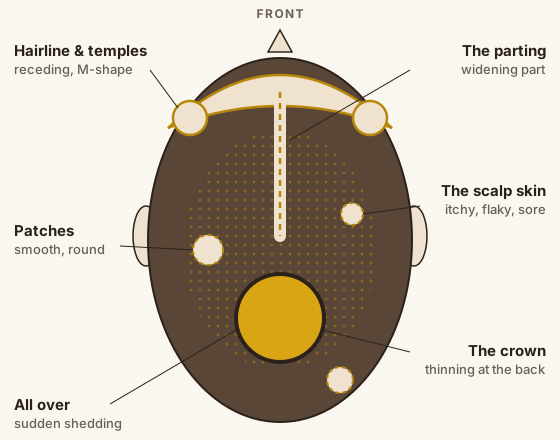
The first sign of CCCA is often noticeable hair loss in the center, or crown, of the scalp. 1 The scalp itself can give clues too.
| Sign | What the sources say |
|---|---|
| Thinning at the crown | Often the first sign. It often begins as a small, round, balding patch. 1 |
| Small bumps | Some people feel small, raised bumps on their scalp. 1 |
| Burning, stinging or itching | Many people with untreated CCCA say their scalp burns, stings or itches. 1 |
| Tenderness | Tenderness, itch and burning are common, though some people have no symptoms. 2 |
| Hair breakage | Breakage may also be an early sign. 2 |
| Shiny or smooth skin | Follicle openings are lost, so the scalp may look shiny. 2 After many follicles scar, the bald area feels smooth to the touch. 1 |
DermNet says the hair loss is slowly progressive. 2 A thinning crown has many possible causes. The thinning crown guide walks through them.
Why early prescription treatment matters
The AAD says starting treatment early can prevent CCCA from spreading outward and causing more permanent hair loss. 1 Some people also have hair regrowth when treatment starts early. 1 Once a follicle scars completely, treatment to regrow hair becomes difficult. 1
Treatment still has a job when regrowth isn't possible. The AAD says it can prevent CCCA from destroying more follicles. The patch can then stay the same size instead of getting larger. 1 Without treatment, CCCA often keeps destroying follicles. The patch may eventually involve most of the scalp. 1
Store-bought products are not the route here. The AAD says you cannot effectively treat CCCA with hair loss treatments sold online or in stores. 1 A dermatologist must prescribe medication. 1
DermNet says the goal is to halt progression and prevent further hair loss. 2 It lists anti-inflammatory options, including potent steroids on the skin, steroid injections, calcineurin inhibitors and tetracycline antibiotics. 2 It says minoxidil solution may help stimulate growth in follicles that are still viable. 2 Which option fits is a decision for a dermatologist. Cleveland Clinic notes hair loss may return after treatment, so some people need medication for a long time. 3 The guide to treatment options explains what each type involves.
A dermatologist can also give self-care tips that can make treatment more effective. 1 DermNet's suggestions include keeping heat to a minimum. It also suggests avoiding styles that cause discomfort, scalp irritation or scale. 2 It says the scalp should not burn when a relaxer is applied. 2 This is care for the scalp you have now. It is not a judgment about the past.
Some people ask about transplants. DermNet says one can be considered once CCCA has been well controlled and stable for at least one year. It adds that graft survival is low. 2 The transplant guide lists questions to ask a clinic.
How hairstylists can help
A stylist sees the top of your head up close, often more clearly than you can. The AAD's CCCA page cites a study on hair stylists as screeners for scarring hair loss within the African American community. 1 A stylist may mention a thin spot, bumps, breakage or a sore scalp at the crown. That is a good reason to book a visit.
Stylists do not diagnose, though. Dermatologist Crystal Aguh says only board-certified dermatologists are specifically trained to recognize and treat scalp disease. 4 She adds that there is still a role for stylists in hair and scalp health. 4
That role continues during treatment. The AAD says a stylist can support a treatment plan with care that minimizes additional stress on the follicles. 4 If hair loss is affecting your self-esteem, a stylist can help you choose a way to cover it. 4 You do not need to cover it, the AAD adds. 4
When to see a dermatologist
The AAD encourages anyone with noticeable hair loss on the top of the head to make an appointment. 1 It says a small area tends to get larger and larger without treatment. 1
A visit matters even if you don't want treatment. The AAD says CCCA is occasionally a sign of a medical problem, like a thyroid condition. 1 The hair loss could also be a sign that you need more iron or certain vitamins. 1
Diagnosis is based on the scalp's features, a scalp biopsy and ruling out other hair loss conditions. 2 The biopsy is taken from the active edge of a patch, not the center of a scarred area. 2 Cleveland Clinic advises reporting when you first noticed hair loss. Mention symptoms such as tingling, burning or itching. 3 It says to see a dermatologist with a lot of experience in hair loss. 3 The guide to seeing a dermatologist about hair loss covers what to bring.
Living with CCCA
Visible hair loss can have emotional and psychological effects. 3 The AAD says a lot of women feel different about their hair loss at various points. 4 Friends, family and support groups can help. Counseling can help if hair loss affects your mental health. 4
People land in different places. Some focus on protecting the hair they have. Some style around a stable patch. Some choose a wrap, a short cut or a shaved head and feel at ease. Each of these is a fine outcome. Being at peace with a changed scalp counts too.
The short version
CCCA is a scarring hair loss that often starts as a round patch at the crown. 1 It is more common in Black women, and the AAD says it usually begins during middle age. 1 Bumps, burning, itching, tenderness or breakage can show up early. 1 2 Hair practices are not a proven cause. 2 A dermatologist must prescribe treatment, and early treatment can prevent CCCA from spreading. 1
- American Academy of Dermatology, “Hair loss types: Central centrifugal cicatricial alopecia overview”. aad.org/public/diseases/hair-loss/types/ccca
- DermNet, “Central centrifugal cicatricial alopecia”. dermnetnz.org/topics/central-centrifugal-cicatricial-alopecia
- Cleveland Clinic, “Scarring (Cicatricial) Alopecia: What It Looks Like & Treatment”. my.clevelandclinic.org/health/diseases/24582-scarring-alopecia
- American Academy of Dermatology, “Hair loss in Black women: Here’s how dermatologists help”. aad.org/public/diseases/hair-loss/insider/hair-loss-black-women
- American Academy of Dermatology, “Hair loss: Signs and symptoms”. aad.org/public/diseases/hair-loss/insider/begin
- Mayo Clinic, “Hair loss - Symptoms and causes”. mayoclinic.org/diseases-conditions/hair-loss/symptoms-causes/syc-2037292
General information, not medical advice. This article was drafted with AI assistance and checked against the sources listed above. Nobody at Balds is a doctor. If something here is wrong or out of date, tell us.