Stopping birth control pills is listed as a possible trigger of telogen effluvium, a temporary type of hair shedding. 1 2 With telogen effluvium, the hair loss usually becomes evident after 2–4 months. 2 The American Academy of Dermatology says hair shedding often stops on its own. 3
It can. Cleveland Clinic lists discontinuing birth control pills among the factors that may trigger telogen effluvium, a temporary type of hair shedding. 1 DermNet also lists the oral contraceptive pill as a possible cause, during use, after stopping or when changing. 2
The shedding does not usually start right away. It tends to show up a few months after the change. 2 4 The American Academy of Dermatology (AAD) says hair shedding often stops on its own. 3 This guide covers why it happens, the timing, how it differs from pattern loss, and what to tell a doctor.

Why the pill can be a trigger
Every hair follicle runs a cycle. Most hairs are growing at any given time, and a small share are resting. 1 A resting hair stays in place until it sheds. Then the cycle starts over. 1
A shock to the system can push many growing hairs into the resting phase at once. 4 Cleveland Clinic says up to 70% of growing hairs can make that early switch after a stressor or change to the body. 1 It notes that telogen effluvium can also result from sudden hormonal changes. 1 Those resting hairs then fall out together, months later. 4
The pill appears on several lists of triggers. MedlinePlus names birth control pills among the medicines that cause this type of hair loss. 5 DermNet describes its own list as "possible" drug causes. 2 It says whether drug-related hair loss develops, and how severe it is, depends on both the drug and the person. 2
The sources used here talk about the pill specifically. For a wider look at medicines and shedding, see medicines that can cause hair shedding.
When it starts and how long it lasts
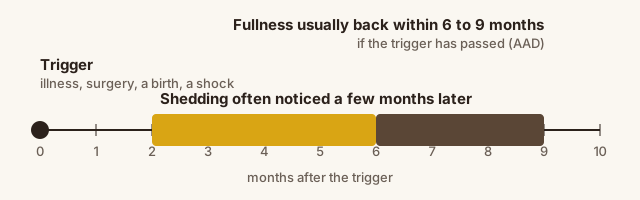
The delay is what makes this confusing. MedlinePlus says you may not notice the shedding for weeks to months after the event that set it off. 5 Here is how the sources describe the usual course.
- Onset. DermNet says increased hair fall is noticed 2 to 4 months after the triggering event. 4 Cleveland Clinic says it tends to happen two to three months after a stressor or change to your body. 1
- The heavy phase. Cleveland Clinic says acute telogen effluvium lasts fewer than six months. 1
- Easing off. MedlinePlus says shedding decreases over 6 to 8 months. 5 DermNet says hair fall tapers back to normal over 6–9 months in most cases. 4
- Fullness. The AAD says that within six to nine months, the hair tends to regain its normal fullness. 3
Because of the gap, the link is easy to miss. Cleveland Clinic notes that many people with telogen effluvium have fully recovered from a stressor or illness and don't see the connection. 1 A change in pills a few months back can fall into the same blind spot.

What the shedding looks like
Telogen effluvium is a diffuse, non-scarring hair loss. 4 Hair tends to come out in handfuls when you shampoo, comb or run your hands through it. 5 Cleveland Clinic says it most commonly appears on the top of the head rather than the back or sides. 1 It usually won't affect your hairline. 1
The AAD puts normal shedding at between 50 and 100 hairs a day. 3 Cleveland Clinic says someone with telogen effluvium may lose up to 300 strands a day. 1 Our guide to how much hair loss a day is normal explains the everyday baseline.
The scalp itself should look healthy. Cleveland Clinic says there shouldn't be a rash, itching, burning, pain or flaking. 1 DermNet notes that a fine fringe of new hair is often evident along the forehead hairline. 4 It calls the shedding, paradoxically, a sign of regrowth, because new hairs push the old ones out. 4 Telogen effluvium does not cause complete baldness. 4
How it differs from pattern hair loss
Heavy shedding after the pill is a different process from inherited thinning. The two can look alike, though.
| Telogen effluvium | Female pattern hair loss | |
|---|---|---|
| How it shows up | Heavy shedding and rapid loss 1 | Slow thinning 1 |
| Where | Most often the top of the head; it may affect the whole scalp 1 | A widened part and thinner hair at the front and top of the scalp 4 |
| Course | Usually temporary 1 | Gradual; Cleveland Clinic calls it permanent without medications or treatment 1 3 |
The lines can blur. Cleveland Clinic says telogen effluvium thinning can occasionally mimic pattern hair loss. 1 DermNet adds that medicine-related hair loss is usually diffuse but may be patterned. 2 It also says telogen effluvium may unmask a genetic tendency to female pattern hair loss. 4 The AAD notes that some people have both shedding and hair loss. 3
See female pattern hair loss explained for how that kind of thinning tends to progress.
What to tell a doctor
The AAD says that if you suspect a treatment or drug is causing your hair loss, talk with your doctor. 3 It warns that serious side effects can occur if you immediately stop a treatment or drug. 3 Any question about your contraception belongs in that conversation.
It helps to arrive with a short timeline. DermNet says a drug history should focus on the three months before the hair loss was noticed. 2 Useful things to bring up:
- Pill changes. When you started, stopped or changed a pill. DermNet says the history should include the oral contraceptive pill. 2
- Other medicines. Any new medicines, dose changes and over-the-counter supplements. 2
- Other possible triggers. Recent illness, surgery, diet changes or major stress. 2 5
- The shedding itself. When it started, any pattern, and whether hair is going from other parts of the body. 5
- Family history. Whether relatives have pattern hair loss. 2 5
Cleveland Clinic says a provider can confirm telogen effluvium during a scalp exam, and may do a gentle "pull test." 1 In most cases no testing is needed. 1 DermNet says that if the cause is unclear, it is usual to check at least a blood count, iron studies and thyroid function. 2 Our guide to seeing a dermatologist about hair loss covers what the visit involves.
When to get it checked sooner
Cleveland Clinic suggests reaching out to a healthcare provider as soon as you notice hair loss, especially if it is adding to your stress. 1 MedlinePlus lists signs that call for contacting a provider. 5 They include losing hair in an unusual pattern, or rapidly. 5 Pain or itching, or a red or scaly scalp, are on the list too. 5 So are acne, facial hair or an abnormal menstrual cycle. 5
What usually happens next
For most people, this kind of shedding passes. Cleveland Clinic says acute telogen effluvium goes away in 95% of cases. 1 DermNet says recovery may be incomplete in some cases. 4 In some people, shedding stays higher than normal for long periods, sometimes for years. 4 That is worth raising with a doctor if it fits.
In the meantime, DermNet suggests gentle handling of the hair, without over-vigorous combing or brushing. 4 MedlinePlus says changes of hairstyle, hair pieces or weaves may disguise hair loss. 5 Our guide to styling thinning hair has ideas. Leaving it alone is also a fine choice.
Shedding like this can be upsetting. Cleveland Clinic acknowledges that telogen effluvium can be stressful, and that you may fear losing all of your hair. 1 It is reasonable to feel thrown by a full drain. It is also reasonable to wait it out calmly.

The short version
Stopping or changing the pill is a recognized possible trigger for telogen effluvium. 1 2 The shedding usually becomes evident a few months later. 2 In most cases it tapers back to normal over months. 4 Talk with your doctor before making any change to a medicine. 3 For more on the shedding itself, read telogen effluvium: sudden shedding explained.
- Cleveland Clinic, “Telogen Effluvium: Symptoms, Causes, Treatment & Regrowth”. my.clevelandclinic.org/health/diseases/24486-telogen-effluvium
- DermNet, “Alopecia from drugs”. dermnetnz.org/topics/alopecia-from-drugs
- American Academy of Dermatology, “Do you have hair loss or hair shedding?”. aad.org/public/diseases/hair-loss/insider/shedding
- DermNet, “Telogen effluvium (hair shedding)”. dermnetnz.org/topics/telogen-effluvium
- MedlinePlus (NIH), “Hair loss: MedlinePlus Medical Encyclopedia”. medlineplus.gov/ency/article/003246.htm
- American Academy of Dermatology, “Hair loss: Signs and symptoms”. aad.org/public/diseases/hair-loss/insider/begin
- Mayo Clinic, “Hair loss - Symptoms and causes”. mayoclinic.org/diseases-conditions/hair-loss/symptoms-causes/syc-2037292
General information, not medical advice. This article was drafted with AI assistance and checked against the sources listed above. Nobody at Balds is a doctor. If something here is wrong or out of date, tell us.