Weaves and extensions can damage natural hair, and even cause hair loss, if proper precautions and care are not taken. 1 The American Academy of Dermatology suggests light styles that do not pull, a professional stylist, and wearing them for two or three months at most. 1 2 If a style causes pain or irritates your scalp, it says to remove it immediately. 3
Weaves and extensions can add length, volume and color. They can also damage your natural hair, and even cause hair loss, if proper precautions and care are not taken. 1 They often require natural hair to be tightly pulled, which can be tough on hair. 1
The American Academy of Dermatology (AAD) says taking a few precautions before, during and after these styles can help avoid these problems. 1 This guide covers preparing your hair, talking to a stylist, how long to wear a style, edge care and the signs it is time to take it out.
How weaves and extensions can harm natural hair
The AAD explains that constant pulling can cause strands to break or fall out. 1 It says the pulling could also damage hair follicles. 1 Once follicles are damaged, the AAD says, hair cannot grow back, leading to permanent hair loss. 1
Tight hairstyles can cause traction alopecia, a form of hair loss caused by repeated pulling on the hair. 1 It can be permanent. 1 DermNet lists regularly wearing tight weaves and braids among the causes. 4 It says traction alopecia starts without scarring, but prolonged and excessive tension leads to destruction of the follicles and permanent hair loss. 4
The AAD notes that weaves and extensions can cause traction alopecia when too tight, especially on relaxed hair. 3 It says that for people of African descent, the shape of the hair follicles makes hair more likely to be damaged from rough or tight styles. 3 DermNet adds that traction alopecia affects people of any ethnic background or age. 4
The condition itself is covered in our guide to traction alopecia from tight hairstyles.
Before you start: get your natural hair ready
The AAD says it is important to take care of your natural hair before getting a weave or extensions. 1 It also notes that damaged hair is fragile, so it tends to break. 2 The AAD's advice is short:
- Start clean. Make sure your hair is clean and free of buildup from products like hairspray. 1
- Condition. Use conditioner to keep your hair moisturized and strong. 1
- Keep it up. Continue this routine during and between wearing a weave or extensions. 1
If your hair is already thinning, our guide to styling thinning hair covers other options.
At the salon: what to ask and what to notice
The AAD advises getting a weave or extensions done by a professional. 1 It also suggests a salon that specializes in these services. 2 These questions are worth asking before the stylist starts:
- How heavy will this be? The AAD suggests weaves and extensions that are light, so they do not pull. 2
- Sewn in or glued? The AAD says dermatologists recommend sewn-in weaves rather than ones that use bonding glue. 3
- How tight will the cornrows be? The AAD's weave advice includes making sure cornrows are not tight. 3
- Can you go easier at the hairline? For braids, the AAD suggests loosening them, especially around the hairline. 3
- How long should I keep it in? The AAD's guidance is two or three months at most. 1
Pay attention while the stylist works. The AAD says that if you feel pain or have a headache, the style is too tight. 1 If it hurts or feels too tight, it suggests asking the stylist to loosen that area. 1 It is fine to speak up in the chair.
How long to wear them, and taking breaks
The AAD says it is important to give your hair a break from a weave or extensions. 1 Here is what its guidance says for different styles.
| Style | What the AAD suggests |
|---|---|
| Weave or extensions | Two or three months at most, then a style without them. 1 2 |
| Braids | No longer than 6-8 weeks. 3 |
| Tightly pulled styles in general | Every once in a while is okay, but avoid wearing them often. 3 |
| Between styles | Loose braids or going natural for a few months, or a break from all styling when possible. 3 |
A break does not have to mean bare hair. The AAD mentions wigs or scarves as ways to temporarily protect hair while it recovers. 3 If you cover your hair, it suggests pulling it back loosely underneath. 3 It says silk or satin coverings are gentler on hair than other materials. 3
Length plays a part too. DermNet notes traction alopecia can also be due to the weight of excessively long hair. 4 For braids and locs, the AAD suggests keeping them short, because longer hair is heavier and pulls more. 3
Keeping your scalp clean while you wear them
The AAD says to keep up scalp hygiene while wearing a weave or extensions. 2 Wash your hair as often as your hair type needs. 1 A gentle, moisturizing shampoo and conditioner help keep the scalp clean and hydrated. 1 Remove clip-in extensions before washing your natural hair. 1
The AAD also suggests gently massaging shampoo into the scalp. 2 When you rinse, let it flow through the lengths rather than rubbing it in. 2
Caring for your edges
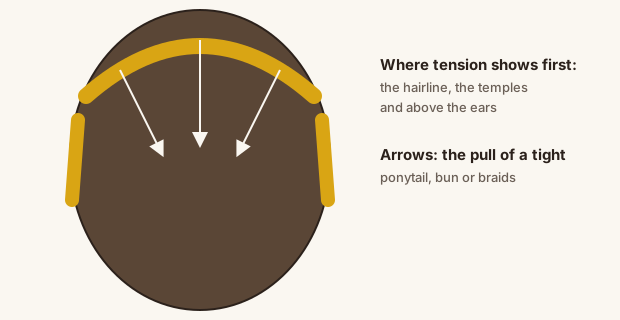
Your edges are the wispy baby hairs that grow around the hairline, and the AAD calls them very fragile. 1 It notes the hairline is one of the first places you can see traction alopecia. 3 DermNet says it mostly affects the front and sides of the scalp. 4
- Use only water-based styling gels on your edges. 1
- Moisturize them with conditioner. 1
- Avoid heated styling tools as much as possible. 1
- Try a style that does not need long-lasting hold products. 2
- Avoid pulling and tugging as you brush, comb or style. 2
If the sides already look thinner, our guide to hair loss at the temples explains other possible causes.
Warning signs that it is time to stop
The AAD names several signs that a style is too tight or is starting to cause harm. 1 3
- Pain or a headache while the style is put in. 1
- Pain or scalp irritation from a weave; the AAD says to remove it immediately. 3
- Tenting, where sections of the scalp are pulled up like a tent. 3
- Patches of hair loss where hair is pulled tightly. 3
- Strands breaking or falling out, which the AAD links to constant pulling. 1
If you wear tight styles, the AAD suggests checking every month for early signs of hair loss. 3 When the pulling continues, it says most people eventually notice their hair stops growing. 3 Shiny, bald skin appears where hair used to be. 3 At that stage, the AAD says, hair cannot grow back. 3
When to get your scalp checked
The AAD says to see a board-certified dermatologist if you are concerned about hair loss, as the sooner an issue is addressed, the better the results. 1 It also says some types of hair loss, including traction alopecia, can be permanent the longer they go untreated. 3
A hairstyle is not always the cause. The AAD notes something else, such as stress or genetics, could be behind hair loss. 3 It lists conditions that are often behind hair loss in Black women. 7 These include CCCA, female pattern hair loss, alopecia areata and telogen effluvium. 7
Our guide to seeing a dermatologist about hair loss explains what happens and what to bring.
Go easy on yourself
Dermatologist Oma N. Agbai tells the AAD: "Don't blame yourself for your hair loss." 7 She notes there are many misconceptions that Black women are causing their hair loss through their styling. 7
Stylists still have a part to play. The AAD says a stylist can support healthy hair care practices, especially ones that minimize extra stress on follicles. 7 It also says you do not need to cover hair loss. 7 If it is affecting your self-esteem, a stylist can help you choose an option. 7 Wearing your own hair as it is, thin patches and all, is a fine choice too.
The short version
Start with clean, conditioned hair. 1 Choose a professional, ask for light styles, and say so if anything hurts. 1 2 Keep a weave or extensions in for two or three months at most, then give your hair a break. 1 Protect your edges with water-based gels and less heat. 1 If a style causes pain or irritation, the AAD says to remove it immediately. 3
- American Academy of Dermatology, “How to prevent hair damage from a weave or extensions”. aad.org/public/diseases/hair-loss/insider/stop-damage/prevent-hair-damag
- American Academy of Dermatology, “How to stop damaging your hair”. aad.org/public/diseases/hair-loss/insider/stop-damage
- American Academy of Dermatology, “Hairstyles that pull can lead to hair loss”. aad.org/public/diseases/hair-loss/causes/hairstyles
- DermNet, “Traction alopecia”. dermnetnz.org/topics/traction-alopecia
- American Academy of Dermatology, “Hair loss: Signs and symptoms”. aad.org/public/diseases/hair-loss/insider/begin
- Mayo Clinic, “Hair loss - Symptoms and causes”. mayoclinic.org/diseases-conditions/hair-loss/symptoms-causes/syc-2037292
- American Academy of Dermatology, “Hair loss in Black women: Here’s how dermatologists help”. aad.org/public/diseases/hair-loss/insider/hair-loss-black-women
General information, not medical advice. This article was drafted with AI assistance and checked against the sources listed above. Nobody at Balds is a doctor. If something here is wrong or out of date, tell us.