Compare like with like over months, not days. Photograph your hairline in the same light and pose every few months and look for the temples moving back or the hair there turning fine and see-through. 1 Slight recession at the temples matches stage 2 of the Norwood scale; deep recession with an "M" or "U" shape is stage 3. 2 Signs of hair loss can be subtle for months or years before they are obvious. 1
Most people who ask this question have already looked in the mirror a dozen times. The trouble is that the mirror is unreliable. Lighting, a fresh haircut, wet hair and the angle of the head can all make a hairline look higher or thinner than it is.
The American Academy of Dermatology notes that signs of hair loss can be subtle, so you may have hair loss for months or years before you notice it. 1 The flip side is that a single anxious look tells you very little. A slow, consistent check tells you a lot.
What early recession looks like
The stages most clinicians use come from the Hamilton–Norwood scale. Cleveland Clinic describes the first three like this. 2
- Stage 1: little or no hair loss or recession. 2
- Stage 2: slight hair loss at the temples, the skin between the ears and forehead. 2
- Stage 3: deep recession around the temples, with an "M" or "U"-shaped hairline. 2
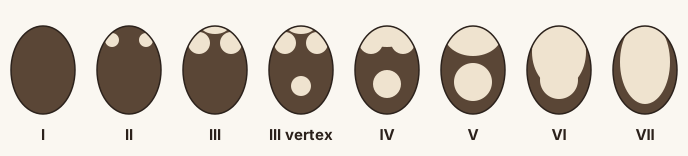
The difference between stage 1 and stage 2 is small, and it is exactly where most of the worry happens. Seeing slight temple changes does not mean the next stages will follow quickly, or at all. DermNet notes that the age of onset, speed and severity vary even within families. 3
The photo method
A consistent photo series beats any amount of mirror checking. Make it boring and repeatable.
- Fix the setup. Same room, same time of day, same light. Overhead light exaggerates thinning, so face a window or a lamp.
- Fix the hair. Dry, combed straight back off the forehead, no product.
- Take three shots. One straight on, and one of each temple with the head turned slightly.
- Repeat every three months. Hair loss from inherited thinning tends to appear gradually. 1 Weekly photos mostly record lighting.
- Compare the oldest with the newest, not each photo with the one before.
Old photos help too. A picture from five or ten years ago with your hair pulled back is a fair baseline, as long as the angle is similar.

Look at the hairs, not just the line
Recession is not only about where the line sits. Pattern hair loss works through miniaturization: affected follicles make progressively fewer and finer hairs. 3 So an early sign is often a band of short, thin, lighter hairs at the temples, where there used to be thicker ones.
Cleveland Clinic notes that a provider may use a tool called a densitometer to look at the thickness of hairs on the scalp. 2 At home, a phone's zoom in good light does a rough version of the same thing. If the front hairs look clearly finer than the hairs a few inches back, that is worth noting.
Common false alarms
- A shorter haircut. Short hair stands up and shows more scalp, especially at the temples.
- Wet hair. Wet hair clumps together and exposes the scalp underneath.
- Shedding after an illness. Sudden overall shedding a few months after a fever, surgery or shock is a different process. It is usually temporary. 4 It thins hair all over rather than moving the hairline.
- Breakage from styling. Heat, chemical treatments and tight styles can break hair along the front. 5 Broken hairs are snapped pieces, not miniaturized ones.
If it is receding, which pattern is it?
In men, temple recession with a family history of baldness is most often male pattern hair loss. MedlinePlus Genetics describes it as starting above both temples and receding into an "M". 6 Cleveland Clinic says the early stages often show in the 30s, though some people see signs in their late teens. 2
In women, a receding hairline is less typical. Women's pattern hair loss usually widens the part instead, and the hairline stays. 6 Mayo Clinic notes that a receding hairline in older women is increasingly common, and links it to frontal fibrosing alopecia. 7 That condition can cause permanent loss, so it deserves an early appointment. 8 Our guide to hair loss at the temples compares the causes side by side.

What your family can tell you
Family history is a real clue, not a verdict. Cleveland Clinic says the odds of male pattern baldness are higher if your grandfather, father or brothers have it. 2 DermNet says the genes involved come from both parents, and that genetic tests to predict balding are unreliable. 3 Look at the hairlines of older men on both sides of your family, at the age you are now and older.
What to do with the answer
If your photos show no change over a year, the best plan is usually to keep taking them now and then. If they show steady recession, you have choices. Doing nothing is one of them. Mayo Clinic notes that many people let hair loss run its course untreated and unhidden. 7
If you want to slow it, timing helps. The American Academy of Dermatology says men who start treatment soon after noticing loss tend to see the best results. 9 A doctor can also confirm what it is. Our guide to what each option involves covers the choices without ranking them.

- American Academy of Dermatology, “Hair loss: Signs and symptoms”. aad.org/public/diseases/hair-loss/insider/begin
- Cleveland Clinic, “Male Pattern Baldness (Androgenic Alopecia): Stages, Treatment”. my.clevelandclinic.org/health/diseases/24515-male-pattern-baldness-andro
- DermNet, “Male pattern hair loss (androgenetic alopecia, balding)”. dermnetnz.org/topics/male-pattern-hair-loss
- American Academy of Dermatology, “Do you have hair loss or hair shedding?”. aad.org/public/diseases/hair-loss/insider/shedding
- American Academy of Dermatology, “How to stop damaging your hair”. aad.org/public/diseases/hair-loss/insider/stop-damage
- MedlinePlus Genetics (NIH), “Androgenetic alopecia: MedlinePlus Genetics”. medlineplus.gov/genetics/condition/androgenetic-alopecia/
- Mayo Clinic, “Hair loss - Symptoms and causes”. mayoclinic.org/diseases-conditions/hair-loss/symptoms-causes/syc-2037292
- American Academy of Dermatology, “Hair loss types: Frontal fibrosing alopecia overview”. aad.org/public/diseases/hair-loss/types/frontal-fibrosing-alopecia
- American Academy of Dermatology, “What is male pattern hair loss, and can it be treated?”. aad.org/public/diseases/hair-loss/treatment/male-pattern-hair-loss-treat
General information, not medical advice. This article was drafted with AI assistance and checked against the sources listed above. Nobody at Balds is a doctor. If something here is wrong or out of date, tell us.